Crystal Range Backdoor Ski Marathon
3/18/2013
(edited excerpts from my log of that time)
The conditions are conducive currently, and deteriorating fast. The snow pack around the house is almost gone. March!? It’s the worst winter since last winter, which makes it the 2nd worst winter I’ve seen here in twenty five. But then if the conditions were better, I’d be touring strictly for turns with the crew somewhere on the more readily accessible peaks. I often end up doing my best exploring, solo when the skiing is crappy. It hasn’t snowed for ten days, it barely froze last night and is supposed to be warm today but partly cloudy and breezy. The conditions look to be crappy enough, maybe perfectly crappy. The stars are coming into alignment, so it’s time to gather my energies for a backcountry marathon day. I’ve skied about 70 miles and 14,000 vertical feet this week already, but the window of opportunity is open now, and I aim to jump right on through. Where the mountains offer a way, I will follow.
Ski touring up canyon behind the house last week, to the edge of the Desolation Wilderness, it occurred to me how much farther I could go if I actually spent a full, concerted day at it, dusk to dusk, way up and over the Sierra Crest and off the backside across Rockbound Valley then maybe even up the dramatic Crystal Range on the farside. The arithmetic says it’s doable, and in a relatively civilized style, no siege tactics necessary, no death march by headlamp. It’ll require a whole trick bag of nordic and alpine ski skills and conditioning, with the timing and temperament to embrace that event horizon and throw it all into motion. Getting to the Crystal Crest will be hard enough, but getting back is the crux. I don’t actually know anyone willing or able, with the gear or skills, and the time or temperament to be able to attempt such a tour, so I go it alone. Besides, it’s more personal that way. Just me and the Mountain. So long as I’m back sipping home brew in my hot tub for sunset.
I have come to see this route in terms of efficiently following the actual terrain just as the wild critters do, instead of merely following the established trail network. This is the natural way for backcountry skiers to look at the landscape, following drainages and ridges, working the good snow conditions with the changing season. It is far more dynamic and connected to the varied topography and everchanging conditions here.
In the summertime, when I can ride my bike five miles up canyon, then stash it and take to foot, I’ve started to apply this approach to finding off-trail routes, to bypass the poorly designed and maintained patchwork trail system. This allowed me to move more directly and efficiently up canyon, to where I wanted to go, not just where some pack trail builder a hundred years ago found expedient. The upper portion of the trails up canyon departed from a trail head from a different direction that is not even accessible anymore, with out an OHV. Trails can become a distracting limitation, giving one tunnel vision. Now I was circling back around in the progression, to utilize that knowledge gained in the summertime, to further extend my ski range.
When it first occurred to me to try skiing the Crystal Range from home in a day, I chuckled anxiously, almost afraid to really consider it, intimidated by the obligation that knowledge might impose. Over decades of studying the topographic maps, and cross referencing with my ongoing explorations afoot, I had gradually brought into focus my mental picture of the terrain surrounding my home, my habitat, and my place in it. This journey took on a certain inevitability once I sensed these pathways and could visualize them, discerning and incorporating them into my mental map. My awareness expanded, bringing together all the disparate angles of engagement, consciousness reaching out it’s tendrils into the surrounding country, through cycles and oscillations, following the fluid flow where it leads. What could be more natural? Somebody aught to, just for the sheer beauty of it.
Rockbound Valley has beckoned to me for a long, long time. I could see the sheer Crystal Range shimmering afloat on the far distant horizon from the top of the ski resorts, when first I entered into this winter realm. It conjured some archetypal alpine ideal, a place apart, beyond mere human concerns. No trails lead there from this side of the range. It is a hard place to know, ‘the backside of beyond’. You can’t see the approach from anywhere, you need explore it blind from above, top down.
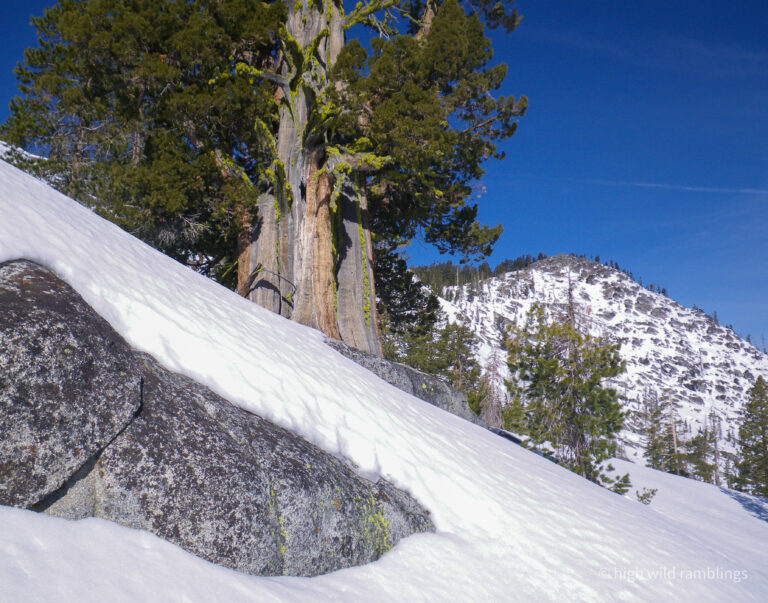
There is a continuous cliff band that guards the base of the west slope down into Rockbound Valley, and so if you get cliffed out, the only retreat is back up to the Crest, and all the long miles home. It requires much time and patience to get to know. It is a place of charmed beauty, mostly open granite, decorated with big twisted old Junipers and gesticulating Jeffrey Pines, well watered in early summer, with little seasonal creeks threading through boulder gardens, so the work has it’s virtues. Across a few miles of canyon, there are a half dozen ways through the cliff band at the base in the summertime, some easier than others, only a couple that don’t require you to use your hands to scramble, to face the mountain, turning your back to the void.
From home, all the way west up canyon is seven miles and 1,300’ vertically to the Pacific Crest, 1,400’ descending the back side, then across the Rubicon river and up the far side 2,300’ to the top of the rugged Crystal Range. And then back. All told, it comes to 26 miles roundtrip, as the Clarks Nutcracker flies, almost all off trail, with 5,000 vertical feet of skiing up and down, much of the vertical being moderately steep and winding amidst rock bands. I’ve got 13 hours of daylight. I check and recheck my figuring. And now it’s just for me to do the actual math, with my feet, showing the work.
The predictive nature of reason and rationality is empowering and allows one to approach the limits of what is possible with a certain calculated confidence, if you trust the math and the powers of your own mind and body, honed sharp through countless thousands of hours of engaged toil. Here in the wilds, these are not abstract concepts or idle ruminations. It actually gets dark and cold at night, whether you have made it home or not. No extensions available, no restart. Likewise, laws of mass and momentum show no leniency, and when flesh meets stone, stone is deaf to persuasion. Gravity doesn’t lie, and it cant be fooled.
First light I’m out the door clomping merrily down the street in my plastic tele boots with my Karhus over my shoulder and that eager anticipation flitting in my gut, embarking on another big adventure, hurling myself into motion, into the randomizing time maelstrom. I relish slipping into the day under the cover of partial darkness; before the wide waking world reveals itself, I shall be well underway. Ahead, I can just make out a form materializing from the twilight. Jogging towards me, she doesn’t see me at first. “oh, good morning.” she replies to my greeting, veering with a start. “Come on dogs!” she hollers over her shoulder, as her canine companions hurtle past me. Dawn has a feminine touch here in the neighborhood.
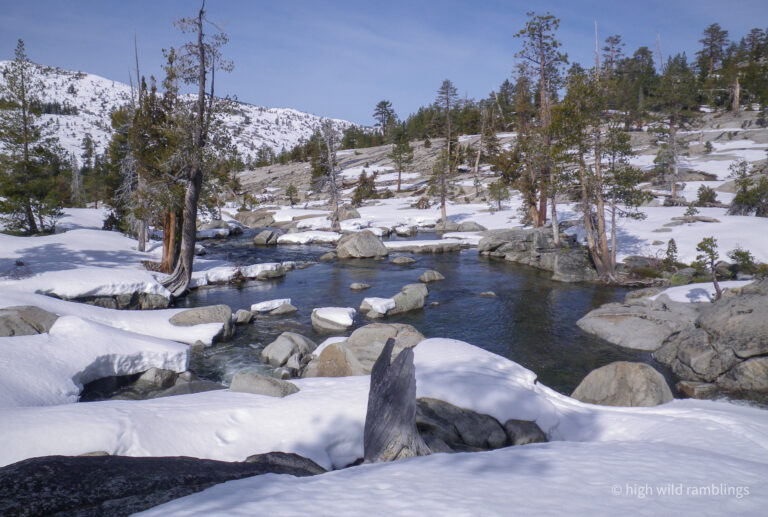
I enter the park through the gap in the fence. The nordic ski trail is melting out and hasn’t been groomed in quite a while. I just keep on walking, the hard, frozen surface crunching under my boots, trying to avoid an ‘atomic ass slam’ on one of the occasional slick spots, where the trail has melted down to that icy layer, from the big rain event we had at the beginning of the winter, over four months ago. At the hill beyond the campground, I click into my skis for the icy chattering skate down to the creek. On the bridge I greet the morning air with contained eagerness, as if greeting a wild thing, gently so as not to spook it. General Creek flows beneath me softly burbling, coursing through veins in the ice, patiently making its way from the snowbound Pacific Crest, where I’m headed.
The snow is still rock hard so I elect to continue walking to save energy, rather than trying to muscle my way up canyon just for the ‘principle’ of being on skis, scrabbling for purchase with my fishscales with excessive poling and core tension, just so I can say I’m skiing. The hard frozen, groomed ski track is a better surface for walking than skiing currently. I’m thinking, there will be plenty of opportunities for struggling today, and I’m not inclined to start any sooner than necessary. If I am to get all the way out to the Crystal Range, I’m going to need to take every little advantage I can, moving smartly, with humility.
At Olympic Meadows I come to me and my wife’s trail from a couple days ago, where it leaves the groomed ski trail out near the end of the loop and heads to the open old growth at the shady toe of the ridge, where I have my usual track broken up canyon all winter. I gingerly position my boot in the binding, seating the holes in the toe of the boot over the pins, gently settling them into place, feeling the engagement and clamping down the toe bail. This practiced ritual is key to keeping these finicky old bindings working, without ruining the boot soles. This is the same style bindings those Olympic skiers used right here over fifty years ago, I muse, and not that much different from the sinew bindings our kind used 4,000 years ago, chasing down the last of the woolly mammoths along the retreating glaciers. Skiing is an organic, deeply human activity.
Some claim the first actual ski races in the world were held by snowbound miners in the gold rush era mining camps of the Lost Sierra, a hundred miles north of here, in the late 1800s. Mankind has been skiing for thousands of years, it was just how you got around on snow, but it apparently only occurred to people to actually officially race them, and of course bet on the outcome, a hundred and fifty years ago? That says something, I think, about our assumptions concerning the merits of our ideas of competition that are currently so predominant. Racing didn’t get us here, cooperation did.
The snow in the meadows is set up nicely, smooth and solid, with a bit of surface yielding, and I am able to skate across, relishing the feeling of glide, and the sense of finally covering ground expeditiously, and the sheer beauty of the skating motion, pushing off your edge to glide on the other ski, and carrying that single legged glide as far as you can, across the open meadows, zipping off into the wilds, beneath stout, lichen festooned old growth Jeffery Pine and Red Fir boles. The rough, groomed ski track behind me is the last human ‘improvement’ I will see today, save my own tracks (and a few jet contrails). The sun now lights the far ridge and I hear a robin’s call, on the job already. They have only just arrived back in town this week.
Following my old track up canyon, through my little bouldering area, and picking my way through the alder thicket, I find the snow too firm to follow in my track where it climbs, and must do more sidestepping and herring boning than I had in the softer snow conditions earlier this week. I absently observe that this will be a bit of a struggle for the next few miles, but shrug and keep moving along smartly, focusing on each ski and pole placement, patiently mindful to maintain a loose ease and efficiency, my attention focused in the moment instead of pointlessly racing ahead into my yearning. I don sunglasses for protection from branches, even though it’s still shady in the deep forest. And it makes me feel like a rock star.
Beyond the Behemoth boulder, I break into the High Meadows and skate along effortlessly, leaving nary a track beside my deep refrozen ruts from days prior, when the pack was rotting out in our record high temps, and collapsing beneath my skis, as it likely will this afternoon, which feels very far away. Following my tracks offers less resistance, and maybe even more importantly, not having to route find through the forest saves exercising my attention. I peer about, touching familiar landmarks with my gaze, high five-ing fir boughs in passing.
I near the bottleneck in the canyon at the five hundred foot tall Striped Crag, visible for many miles in many directions, with big dikes of quartz slashing diagonally across it’s face like healing scars, marking a powerful rending deep underground, so long ago. The glaciers backed up behind this obdurate bottleneck, carving it deep and smooth. Humans too, have backed up behind this obstacle, generally leaving this drainage alone. There never has been a continuous through road, no skid track, not even much of a trail, bicycle riders have to push their bikes for a half mile here above the choke. Mostly the bears and deer are responsible for keeping things passable around here, but only to their own minimal standards.

Just above the bottleneck, the canyon doglegs in a glacial crossroads here, a topographic nexus. From it’s head, the canyon flows northwesterly a few miles, paralleling the crest, four hundred feet above, and then beneath Lost Corner Mountain, it bangs a hard, joint controlled, right turn, northeasterly in a straight shot towards Tahoe, bounded by symmetrical medial moraines shared with its neighboring canyons, reflecting the clean, massive lines of the local underlying geology. The great Rockbound valley glaciers overrode this low portion of the Sierra Crest from the west just above this dogleg, adding their might to the much smaller General Creek drainage, to carve out the step canyon walls, trailing the long moraine ridges out into the lake. But it appears things backed up behind the bottleneck at Striped Crag just downstream of the dogleg, encouraging the glaciers to spill out into the adjoining canyons over low saddles to the northeast and southeast into Mckinney and Meeks Canyons, and back across the hydrological crest northwesterly into Miller and the Rubicon.
And as the snows flowed, so flows the folks. There is a hundred year old trail that connects these three canyons here, eroded from long term stock use in the past, with ax-cut tree blazes nearly healed over, from the era of the mineral springs resort at the base of the west slope, across the crest where Miller Creek flows into the Rubicon River, in the late 1800’s. But this old trail did not really connect well to Lower General Creek, below the striped crag, it being too rough for most horseback riders, with the forking junction up on the odd jog in the hydrologic crest between Miller and General creeks, not conducive to continuous travel up General Creek, since it too was built to and from the Miller lake trail head there. It’s hard to believe the current extremely rough dirt road they named a Jeep after, was once driven by stage coaches and Model A Fords, in part to access this backcountry trailhead. Before that, it was a trade route for the neighboring Nisenan and Washoe tribes on either side of the Crest, and for far longer before that, just the deer, bear, lions and wolves.
In the meadows, I work around a marshy dogwood copse where beavers have dammed the creek into braided sloughs. I can see tracks where the large rodents have emerged from the creek to collect fresh green boughs and then slid back down the snowy banks on their bellies, kersplash. I picture them snug in their lodge beneath the snowpack, feeling the vibration of my passing. We had long been taught here, that beavers were a destructive invasive species in the Sierra, it was in all the natural history books, etc., but now wildlife biologists are finding that the beavers are indeed native here, and are only now recovering from the predations of the Gold Rush era. It is after all prime habitat. It’s pretty funny that the naturalists apparently never thought to consult the natives (not haha funny)
The day’s first long sunlight streams in low, penetrating the forest, perfectly lined up to shine down a straight stretch of creek bed, flashing on the face of the splashing water where it cascades over boulders and snags, sparkling off the ice formations, where the splash solidifies like travertine. The moment glistens, and I pause to inhale that fleeting sparkle.
And I press on, up along the lovely creek as the gradient increases and it becomes more rockbound, cautiously admiring the pools and falls, mindful of my edges, striding above the rushing waters. At the summer trail crossing, below the Triangular Pools, almost five miles up canyon, I stop, clip my 500 ml Nalgene bottle to my ski pole basket and dip it down into the current, from up on the snow bank. I drink half and stow the rest in my pack. I carry only a liter in my hydration sack, which I use as backup, doing most of my drinking from creeks I trust, as I cross them, shyly greeting the microbes that reside in each spot, like new friends I am eager to show my trust to, not wanting to offend, in hopes of reciprocation.
Above here, the trail comes to the south side of the creek, and I in turn cross to the north, onto the snow covered talus field beneath the Striped Crag. Upstream I then recross to the south side where the trail itself crosses back to the north. I don’t intentionally try to avoid established trails. It just sort of happens naturally. Snow cover presents new options for covering ground. I follow the terrain itself and the varying snow conditions it presents, with little regard for expectations.
The snow is still quite firm, and I can feel the extra strain in my shoulders and knees, from trying to maintain purchase all these long hours. It’s quite the core workout, maintaining body tension for miles through technical terrain. I decide to give myself a break, and share the work around to another muscle group, stopping to put my climbing skins on to climb more directly away from the creek where I cut off the big dog leg. As I hook the skins over the ski tip and line them up, smoothing the adhesive onto the bases with practiced motions, I munch on handfuls of dried persimmons and cashews.
I spy what looks like an old blaze, maybe a hundred years, mostly healed over on the five foot diameter trunk of an old Western White Pine. Did the old trail follow along closer to the creek bank than the current one, which follows the 1960’s era logging road to Lost Lake for this little stretch. The early pioneers around here were likely following existing routes used by the natives, the Nisenan from the west side and the Washoe from the east, crossing the Sierra to trade goods.
Skins on, I proceed, dismayed at how slow and leaden the skis now feel, my wings trimmed, glide traded for purchase, speed for ease. But when I point them uphill they grip and I can relax onto my leg bones, more confident in my footing, and swing my arms loosely unencumbered. I follow my old tracks still, saving myself the route finding, which takes more effort than one might think.
Today’s trip is the culmination of three recent tours up this canyon, each building on the knowledge gained in the last, and pressing the track further up into the wilderness, connecting different cross country routes I have sussed out through the years of travel in this area, mostly in the summer, when I can ride my mountain bike for much of the approach. This is a different world now though, Planet Winter is far more exposed and remote. I haven’t seen a recent track up here that isn’t my own all week.
My lonely ski track arcs up through the forest, smoothly and accurately linking openings. There is a flow in the wilds, a clean way through that will lead you on, the path of least resistance. My track moves straight and sure, with purpose and awareness. A properly broken trail fits the landscape organically, as natural as the subtle swale of a time worn game trail. All us critters naturally find the water worn weaknesses in the terrain, and by our passage we reinforce this path, like patterns of practiced thought reinforcing the neural pathways in the emergent plastic meta-brain that comprises this planet.
On top of Snowy Knolls, the low, rounded glacial carved bedrock granite outcrop in the canyon bottom at the prominent bend in the canyon, I stop to rip skins, flipping my ski tail up behind me to grab the tail of the skin and peeling it off the ski base as I snap the ski back. The skins are extra sticky in the cold and I have to pull extra hard, balancing precariously with one ski in the air behind me, having a slapstick yoga moment. I give the skin a final vigorous jerk, and snap my ski back under me with a spastic lunge, the skin whipping around behind and smacking me in the back of the head, just like I figured it would. At least it doesn’t stick in my hair like fly paper. We’ll save that for the ‘comic book’ version. Ah, the dignified elegance, the ‘freedom of the hills’.
A chicakadee calls out plaintively for a ‘cheeese burger’. I check the time, resigned. I have lost an hour already, in just two. These firm conditions are really slowing me down. Good thing I left an hour early. I’m hoping the slipperiness will make for a quick traverse down the backside anyway, so I can make up that time. It’d be a shame to come all this way again and not get to the top of the Crystal Range, but I’ll let the timing decide.
Skins off, I’m loose again, kicking and gliding, my skis feeling like they are a part of me. The snow has begun to soften as I cross lonely upper General Creek to the toe of the Pacific Crest, at Rattlesnake Ridge. Here I once again put the skins on. The transition back and forth between skins is a bit tedious but as long as I do it smartly it nets ahead, so I take the time, once again, trying to avoid rushed false economy. It’s a rest for my legs and cardio, just busywork for my hands and attention, which makes the walking easier, more attuned to the conditions.
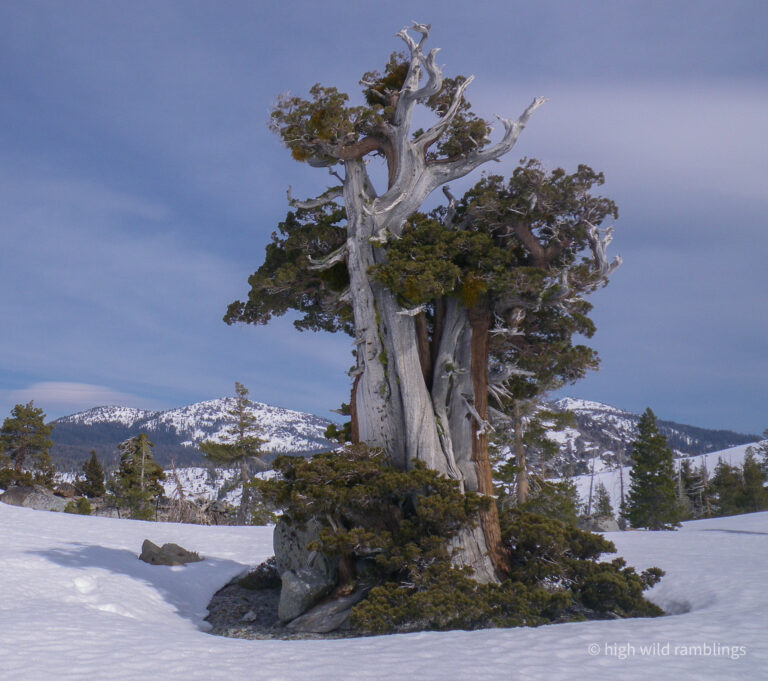
I climb the ridge, familiar from my summer travel, greeting a massive old Juniper in passing; nodding, howdy neighbor, long time, eh? Circling above the tree I see what looks like the remains of ski tracks, raised in relief in the old snow where it peaks out from under the most recent. I am quite surprised, and somewhat delighted. So someone else knows this ridge? how cool. Who could it be? By now I thought I knew all the local BC hardcore and their ways. It’s funny in the wilds, how two’s company and three’s a crowd. These tracks are weeks old. Not really so much company, actually.
A quick four hundred foot climb takes me to the actual hydrologic Pacific Crest. I look back over my shoulder at a little wedge of Lake Tahoe, and the backside of the west shore peaks, and the Striped Crag where it guards my entrance back into lower General Creek, and home five miles below. The crest is low here, only 7700’, it was overtopped by glaciers in the ice age, rounded and tree covered, old growth red fir and white pine. Anticlimactic? The real drama still lies to the west.
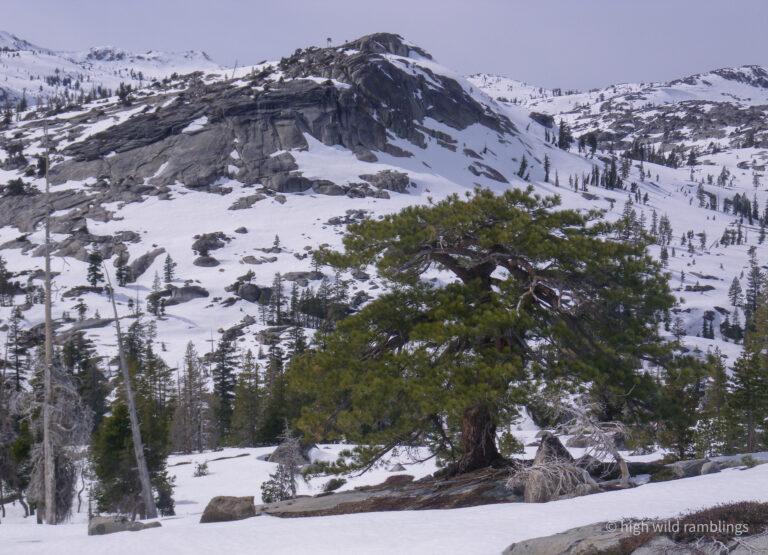
I follow along the ridge top until I break out of the trees and the view beyond opens up and I can see the magnificent Crystal Range towering sheer above wide open Rockbound Valley, the Rubicon River coursing through its scoured granite depths, containing within it’s embrace, this whole wide open space, this vast mass of air, hanging lightly, conducting light and sound, creating broad perspective, a powerful sense of positioning, and presence, the landscape’s narrative laid bare. The Crystal Range looms large in the local psyche; it is visible from great distances, including from the big ski resorts, it’s chiseled features hovering on the horizon like a far off Shangri la, a removed vision of the alpine architectural ideal, looming large with scant trees for scale. And now here it is right before me, with only this snow dappled rockbound canyon yawning between us.
Five days ago I toured up from Meeks Canyon just for this view. Meeks is a shorter access, since I cant use my bike this time of year, more direct, but more rugged. But I struggled with the marginal coverage and numerous downed trees, outcrops, alder thickets, and other such obstacles. I was able to gain the crest ok, and ski most of the way to the Rubicon River, before running out of snow, and mojo. And I decided to vamp, and ski back down General Creek to get home. Six days ago I had skied up General Creek to the dogleg so I knew it was more conducive.
And when I was here three days ago, on the way back, I intentionally broke a gentle, direct, trail climbing from the river, traversing up and across slope for a couple miles on continuous snow, towards my low notch in the Sierra Crest at Rattlesnake Ridge, for future reference.
I find that track now and zip along it, heading down directly cross slope towards the only viable river crossing for miles, just like I knew where I was going. Another of the beauties of snow travel; you leave a track making subsequent travel easier. I contour rapidly across an open slope studded with boulders and specimen Juniper and Jeffrey, all arranged just so, as if I were skiing through a museum.
I stop to scope out my route to the Crystal Crest. I had originally been envisioning the impressive southeast face of McCon Peak proper. From where I stand now, it looks really steep. The snow underfoot is still quite firm. The steady breeze is brisk, inhibiting softening. My lightweight waxless metal-edged touring skis feel like styrofoam, and there is a hollowness in the pit of my stomach at the thought of being on that face.

At home I poured over the contour map, looking for more gentle slopes with a more southerly exposure to allow for a friendly sun softened ski surface. I wanted to be able to link decent turns in style, not skitter down some scary boilerplate, survival skiing. I spotted a gentle rib where the contour lines spread out, facing southeastery, that would allow for easier passage to and from the crest, in theory anyway. Now, here in real life, I could make out that ramp I had found on the map, a low-angle sub-ridge with widely spaced trees, surrounded by steep open faces, leading quite naturally from the high McCon lake basin directly to the crest, a nice gentle route surrounded by forbidding terrain, mountaineer style.
To get there, I must ply a route up amongst the jagged glacial scoured facets of granite cliffs, the repeated geometric pattern of this area of the range. In my minds eye, my route will wander betwixt the row of huge teeth like a pilot fish into the maw of the behemoth. That gentle ramp with the friendly forest looks kind of inviting and I muse on the elegance of the path of least resistance. McCon’s headwall may scoff, mutely mocking me, on behalf of dogmatic hypercompetitive mountain jock, peakbagger types everywhere, but that ain’t me. I’m just a dedicated art lover, a feral dancer who likes to go in deep. Being fit just means you get to suffer for longer.
Turning away, I resume gliding, keeping a close eye on my track from three days ago as it winds amidst the melted out granite slabs and the twisted old junipers. This west slope of Rockbound valley, for miles and miles, has an open park-like feel, with specimen krumholzed, snow sculpted Junipers intermixed with stout old Jeffreys and Red Firs, their boles burnished a honeyed hue, listing and storm battered, composed in archetypal sympathy with the smooth polished granite. The snow is drifted decoratively into hollows of the terrain and freshets thread their way down the slope, fanned out across the slabs, cascading over clean edges in curtains, their merry sound inspiring that John Muir sparkle. It is exquisite to see where the refrozen snowpack lightly touches the scoured striations on the bedrock, a glimpse of that glacial world that sculpted our classic alpine terrain and plowed up the fertile till to nourish one of earth’s great conifer forests.
I have little time now to pause and admire, but the stream of thought runs on, as I cover ground, all things in motion before my eyes, artful compositions form and dissolve in passing. Grace comes a half step ahead of the flow of time, skipping out of the beat like joyful creek spray arcing, pausing midair, momentarily motionless, before falling back into the flow. I rip a few quick turns through a narrow spot in the rock and come carving out with speed, banking, spraying granular corn snow across the bare granite, relishing the pull of momentum at my innards, the water that is me joining that joyful flow of mass in motion all around.
My track follows along the top of a bench, beneath the crest, cross slope to where I hit a draw that follows along the edge of a hog back ridge that leads strait down to the river, right where I can cross above the top of a ravine at the base of a cliff band that guards the toe of this slope for miles; familiar terrain, in a new guise. It’s a route I have developed here in the summer through the years of wandering this canyon, walking the granite byways. To have this terrain now flying beneath my skis is a thrill, and I catch myself grinning and chuckling with bemused satisfaction, feeling thoroughly blessed with the magic of snow travel. What a wondrous world we are part of.
When I scouted this route, a few days ago, searching for a way to cross the Rubicon River, running swift and full with snow melt, I could see that the only continuous strip of snow running from the Sierra crest to the river in this neighborhood lay in this draw, where the terrain served as a natural trap for the windblown snow, and shaded it from direct sunlight. I find it interesting that the natural byway I had found here in the summer is also a natural ski path in the winter, likely not a coincidence, as the lingering snow restrains the vegetation, keeping the path clear, and leaving an open space for the snow to settle, in another one of those marvelous reciprocal feedback loops. And here too, the only snow bridge I could find across the river lies at the base of this confluence of terrain features, here where Phipps Creek joins the Rubicon. The white carpet rolls out before me….
I sense there are natural corridors out here, time worn paths of least resistance, underlying the topography, ‘joint controlled’ by the cracks and weaknesses in this massive batholith, which date to it’s formation deep within the earth, and have since been lifted up and worn down and accentuated by rivers and glaciers and followed by the herds of ancient game, and the two leggeds who were subsequently to hunt them. And now here I retrace these same folds lovingly. And though I can not explain it, I feel a welcoming intimacy, like I am a part of the goings on in these ancient wilds, a connection sparked within the furrowed folds of the cosmic mind, at which I probe like a sculptor looking for inspiration in the underlying grain of the medium.
Nearing the bottom of the canyon, I can hear the river roaring, rolling rocks along its bed. The snowpack becomes even more meager and I work at extrapolating my old track over stretches that have melted out in the meantime, reflecting that this route may not be skiable in a few more days. I’m real curious to see the status of my snow bridge over the Rubicon, after another couple days of record high temps. Doing a tour of this sort in these conditions isn’t the most obvious call. I traverse a narrow edge in time as trends in the changing conditions converge and cross. The snowpack shrinks as the daylight lengthens. The thawing process produces the conditions most conducive for ease of snow travel, up to the point where it melts away and is no longer continuous, and just becomes an obstacle. I work the margins. Timing is everything.

I link up some nice turns in the now softening snow, winding around bushes and boulders, sidestepping gingerly over logs, pushing through alders, greeting in passing a distinctively kinky little old Jeffrey Pine, which serves as a landmark when trying to find this route from below in the summertime. I approach the river with great relish, breathing deep the ozone released by the colliding water molecules, imbibing the energy of the chaotic turbulence. I dip my bottle into the current and drink long and hard, till my sinuses ache from the cold. The chill snow melt contains traces of this season’s powder turns. I pull out my camera to check the time. I have come the 10 miles from home up and over the Pacific Crest in 4.5 hours which means I have made up the time I had lost, and then some. I relax a bit, figuring if I can stay on pace for the rest of the day, I will have enough daylight to complete my journey, just.
I slide to the edge of the Rubicon, where Phipps flows into it. With dismay, I find the snow bridge has settled, opening a large crack. The river rushes heedless beneath it. And what kind of rotten muck will the bridge be a few hours from now on my way back home? I peer upstream, trying to retrace its meanders in my memory, where the boulder hops are, or the shallow fords that might have snow cover, or deep narrow spots that might bridge. I know from my reconnaissance that there is no crossing downstream for at least a couple miles. I sigh. Already I am losing time again, I observe, amused, resigned. This could take a while.
And if I don’t find a crossing? I have come all this way hustling since dawn, for a third time this week. This is not just an idle tour. I’ve made down payments I need amortize. No. I believe that is what you would call the ‘sunk costs’ logical fallacy or heuristic trap. It is also crass. This I do as a gift to myself, so when I climb the ridge behind the house and peer out to see the Crystal Range shimmering on the horizon like a mirage, I will smile the secret smile of self-knowledge, looking back across time and distance to this flash across the landscape, a recombination across turns in the grand mortal coil. If I force my way where I am not welcome then I shit on all that. I will be thankful to receive what I am offered.
I go back to take a closer look at the snow bridge I used the other day. Maybe it isn’t so bad after all? I poke at it with my pole, probing for the solid layer underneath, finding it still frozen. I can see settlement cracks around the edges of the creek, where it had sagged during the heat of the day yesterday. Nothing excessive though, just what you’d expect. I’ve seen worse. It didn’t actually collapse anyway. And as I get closer I can see that the sagging center of the snow bridge, is partially supported by boulders underneath. I carefully maneuver my skis out onto the snow, arranging them to distribute the forces to the supported areas, like an engineer constructing a span, as I go. Skis make a good bridge.
I unbuckle my pack and remove my pole straps, arrange my skis, tentatively testing that first step, and then push off, gliding lightly, and with a well-timed couple of shuffling strides I cross the void. And there it is. I have crossed my Rubicon. I shuffle off, almost giddy with the commitment, looking over my shoulder, as if I might be getting away with something. I can feel the tether stretched thin, my ties to sustaining civilization, down to a few strands. The ski track from my house that has unspooled behind me is nearly the only human sign for a hundred square miles.
I pause to eat a slice of pizza not because I feel like eating, but because I know I need to. Keeping the calories cycling can be the crux of these high-exertion twelve-hour days. Besides, pizza is kind of hard to digest while toiling, so it’s best to eat a little bit at a time. I think of my wife as I eat her pizza, olive and onion on a sourdough crust, made with extra love, and a fennel seed in my teeth for a bit of flavor, later.
The terrain here on the west side of the Rubicon is more heavily glaciated, worn down to bedrock by the accumulating snows on this more shady, lee, northeast facing mountainside. Here the big clean lines of fracture in the granite are everywhere apparent, the same faceted triangular shapes appearing here and there, on varying scales, at that same angle where the two predominant planes of weakness in the rock come together.
I retrace this geometry with my skis, switching back and forth, working the natural weakness to make my way uphill. Contouring away from the river, the fish scales give sufficient purchase, resisting the urge to switch over to skins any sooner than necessary, gliding here and there to make my way. I deploy my climbing skins for the more sustained climb at the base of the ridge, consciously choosing efficiency over speed, using my legs more and my arms less, at a slower, more modulated pace. So often, we let our native pack mentality and competitive spirit override simple arithmetic. And the stronger that one is, the further he can get away with such faulty decision-making based on emotion and primal urges rather than reason, and the further he will need to backtrack to get back on-route. This is a subtle trap and one that the savvy mountaineer recognizes in his own decision making and compensates for, at least when optimum efficiency is required.
Today I am going with efficiency. For this reason too, I elect to climb the more moderate south facing treed ramp to the crest, where the snow will be more pliable, rather than forcing the more striking, direct east face to the more northerly summit of McCon Peak proper. I marvel at my surroundings as I climb up into the amphitheater, like a bug crawling into a stone flower. The snow buries brush and talus, making this glacially scoured terrain even more stark, my whole sense of scale drifting off existentially.
There is a steeper face below the ramp, which seemed like it could be a nice ski line, directly down to the little lake there, which is obscured by the intervening country, and I climb eager for the view to reveal this terrain, this next puzzle piece.
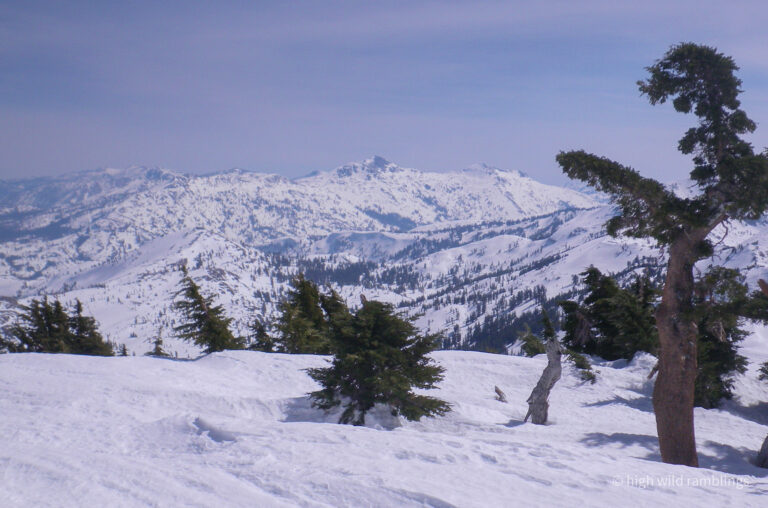
The snow is mostly freeze-thaw consolidated and supportive underfoot, and the surface is softening nicely, with little ‘powdery’ new snow lingering from a couple weeks ago. This remnant old snow is yet to be fully transformed through the corning process on the slopes that don’t get direct sunlight, but here on the more southwesterly slopes that are tilted more steeply into the hot equinox sun, this transformation is progressing nicely, making for easier skiing up and down. The absorbed solar intensity is proportional to the angle of incidence, so slopes that are angled up into the climbing sun corn up more readily, as I had hoped. Here too, there is satisfaction in finding my trust in the science validated. Snow can be inscrutable, but the laws of physics do apply.
Mastery is simple. Just keep getting a little bit better for a long long time (10,000 hours?), which merely consists of finding your mistakes, and fixing them. Self assuredness and confirmation biases are clear obstacles to this process. The strength and techniques I use here are worthless without the insight and discipline to humbly choose and execute my route, a vision tempered by years of mindful experimentation out here. It is the accuracy of my mental picture that I have developed that will be tested; based on the real conditions and my real abilities.
It is so easy to be distracted by our notions of how we think things should be, or how we want them to appear, and our pandering culture encourages this, and our affluence enables it. We hang on blindly to our reassuring certainties, precious assumptions and flattering oversimplifications, instead of facing the uncertainties squarely. No entitlements or exceptionalism in the wilds. The coyotes don’t care what kind of superior, intellectual monkeyman you think you are, they’ll pick your bones regardless, when you crash and burn.
With the immediacy of this feedback between external reality and interior perception (object/subject), we approach real connectedness with the rest of creation, and maybe even grace, and a return to the wild Eden we were led to scorn and abandon so long ago. Covering this ground allows it to mold me to its ways, with an emergent wisdom. It’s about trying to listen and learn from creation, tuning in to that world that evolved us, while quieting our jabbering minds, full of childish willfulness and naïve fairy tales, trying to superimpose our simplistic narratives over the much deeper, more subtly ineffable truth.
Cresting the bench that holds little McCon Lake, I can see that the face below the ramp looks like good ski terrain, steep, but continuous and the surface is smooth, glistening invitingly in the sun. I figure I can gauge the snow quality on the way up and either take the gentle ramp back down or drop into the steeper stuff. I work at keeping my head in the game, continuing to break my route down into sections as it unfolds, remembering to look up ahead when vantages present themselves, charting my way, so that at any given time, I not only maneuver my skis across the variable snow surface and around the trees and rocks I encounter, but I also moved across the map in my head, following each leg of the route where it connects to the next.
A Clarks Nutcracker squawks as I crested into view, sounding a bit peeved at having his privacy invaded, and likely a bit surprised to see a human here this time of year. I laughed out loud, apologizing. I have a fond affection for them, as some of the sole year round denizens of these high forests, and tenders of the beleaguered Whitebark Pine groves, in particular, as primary distributors of their seeds. Such partnerships allow each to live in a place so forbidding, neither would survive with out the other. It is a subtle balance, which hinges on these treeline Jays burying just enough seeds to sustain themselves and enough extra to reseed the Pines. There is no allowance for taking much more than you need in real life. There lies the balance point humankind will need to seek, to survive for long. Take only what you need, and leave the rest.
Now I work around the lake towards the base of the ramp. The terrain keeps on pushing me towards the south, away from my destination. I resist the impatient impulse to just cut upwards and start climbing the steeper face. I am reluctantly realizing as I get older, that steeper is less efficient, that it’s more of that perversly lazy false economy. I need to leave a little something in the tank for the long ski back home, and so try to be disciplined and take every little advantage I can. This too is key when pushing limits.
Eventually, I am able to contour around the little crag at the base of the ramp and start my gentle climb to the crest. I love how the natural breaks in the terrain here, the way our granite fractures and cleaves, allows for the organic ski tendency to switch back and forth when climbing, and likewise on the way back down, turning across the fall line. This is wave mechanics, the way masses behave when in motion, oscillating with the gradient, gearing down for the grade.
I’ve heard it said, that when humans started to walk erect, among other things, it allowed them to separate the mechanics of locomotion from the working of the lungs, which were no longer compressed by the action of the forelimbs with each stride, and so we can slow the cadence of our breathing while maintaining the pace of our striding, effectively giving us different ‘gearing’ options and allowing us greater endurance, and an another advantage over the four legged.
On this low angle ramp I try to lengthen my stride and slow my turn over to net to the same cruising speed, and I start poling on every other stride, halving the work my upper body must do, slowing and deepening my breathing and heart rate. Maybe these are just the games I play to distract my mind from the mounting exhaustion and the various aches and pains.
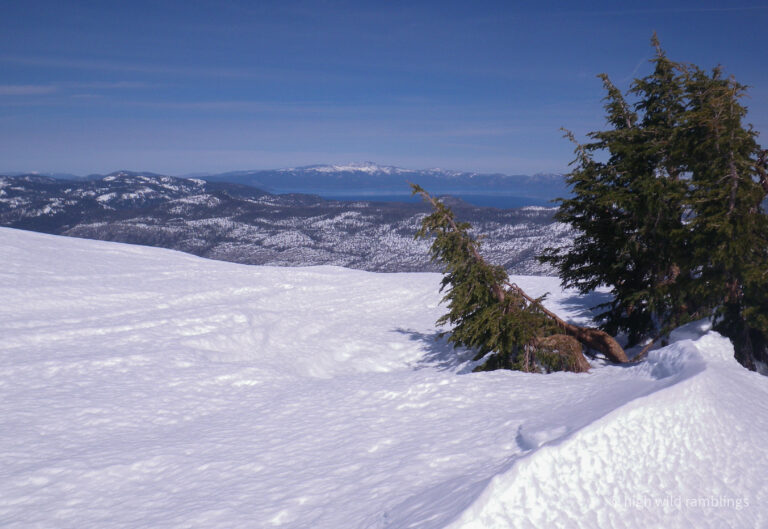
I look up from my navel gazing to marvel at the sheer snowfields gathering around me as I near the ridge top, entering that rarified realm amongst the peaks and precipices, eye to eye with giants. I look over my shoulder, peering across the vast openness of Rockbound Valley to what is obviously a far bigger valley beyond, that looks improbably like it is filled half full of sky, the massive blueness hovering like a mirage. The further you get from Tahoe the bigger it looks. I smile, picking out the spots around the basin where I like to ski, and think about being in those places and looking out here and seeing the Crystal Range, where I now stand, shimmering in the distance like a symbol of untouchable wildness, and I feel the connections arc through space/time like silent lightening, like new neural paths emerging, sparks jumping the gaps. I feel like just another piece of this place, a wind tossed speck in the maelstrom of time. You’ve got to embrace being small, to be a part of something this big.
Shuffling up the low angle ramp, I marvel at how such a gentle way can even exist, amidst such imposing terrain. As a mountaineer, it defies reason, how often the terrain offers us just what we need to get through. It is as if there is a flow, a groove, that underlies this landscape, that allows all of us Children of the Water to make our way. Sculptors speak of revealing the underlying form that is already present in the medium. Musicians speak of being a channel for a muse, or the music of the cosmos, being a conduit for some external source rather than so much creating the music themselves. Neurologists speak of existing neural paths being revealed and reinforced, rather than forged from scratch. I think I know what they all mean. Dancing I’ve found, it takes a certain level of focus and effort to get up to speed, on the one in time, but then with a certain detachment, it unfolds of its own accord. I feel this active passivity is the fertile ground where the seeds of grace might take.
And next thing I know I’m on top. I remember when I was new to backcountry skiing, on big climbs I would peer up at the mountain towering over me and feel oppressed, dreading how long it would take to climb. I would find myself constantly looking upwards to see how much closer the summit was getting and being constantly frustrated with how long it was taking, lifting the lid, to see if it was boiling yet, while letting the accumulating steam out, slowing the whole process down. I find I don’t do that anymore. Partially this is because I am more fit physically, but I think, even more importantly, I’ve learned to keep my head more in the moment, focused on the climb and my surroundings, rather than letting my mind race ahead, trying to project itself into the future.
I’ve learned to slow down and really enjoy the steady pace of climbing uphill on skis, even though I am actually moving quicker than I used to. It’s my expectations that have slowed. I know it will take a long time, but I also know I can make it. Endurance is, to a large degree, a mental exercise, a maturing of our relationship to time. For me, it also reflects an evolution in my reasons for traveling in the mountains. It is much more process oriented, and less about trying to achieve some preconceived goal just so I can say that I did it.
My high point on the Crystal Range here is not a named peak so there is no cairn on top, no summit register, which makes it so much more intimate and personal. Most of our named peaks are just little bumps in a long ridgeline anyway, a product of our consumer cultures need to name and commodify everything. I doubt the natives attached such arbitrary value to each and every bump along the way, or affixed place names that weren’t related to utility or specific spiritual significance.
I am thrilled with this natural route the mountain has offered me, and grateful. From the Crystal Crest I peer down the other side, the foothills falling abruptly away, rolling forests studded with reservoirs dropping into the smog veiled Central Valley below. Beyond it, the Coast Range pokes above the pall, and the Pacific Ocean rolls away unseen beyond, clear to the other side of the globe.
I gaze up the ridge, to the east face of McCon Peak glistening in the sun. It doesn’t look so steep from here and the snow quality seems good. I have a pang of doubt, wondering if I shouldn’t have opted for the more challenging route, still caught up a bit in that bind between trying to follow where the mountain would lead me, and trying to impose my own expectations onto this journey.
I’ve skied that face a few times, originally day tripping from a campsite on the dirt road on the west side of the Crystal Range, accessible in the late spring, a two or three hour drive from home. Then I skied it on a nine-day late spring Rockbound backpack ski and fishing expedition with my wife, with food and gear stashes set up, riding our bikes for the first four miles from home. Though I will add that when I skied it in the past, I had on bigger, stiffer, heavier downhill skis, with beefy cable bindings, and taller, stiffer Telemark boots, far more conducive to making steep turns in challenging snow conditions. Now here I am day tripping it from home, managing almost a vertical mile of descents on what are basically Nordic skis, with a marathon’s worth of mileage, almost completely off trail, no tracks in sight but my own.
Our culture glorifies the visionary who imposes his will upon the fierce mountains, chooses an impressive, recognizable objective and tenaciously battles his way to success and glory, and heroic feats are accomplished, in mountaineering terms anyway. But what has been missed along the way? What insights were forfeited through all this willful imposition? The world is trying to teach us, but we are too caught up in our own petty, make-believe stories, to notice the real one unfolding around us. Go figure. You give a baby a book, and they try to eat it.
In part, my cautious and analytic nature has led me to this realization, for there is safety in staying flexible and trying to read the situation and choose the way that seems most conducive, on the fly. But this takes more patience and openness to tolerating the uncertainties, and a reliance and confidence in my own ability to judge. It is a greater challenge. It is simpler to just choose an objective and route, and dogmatically stomp on the gas pedal, spinning your wheels till you get there, exposing you and your partners to more likely mishaps along the way. Of course, the mishaps add spice to the story when retold. When things go smoothly, even sublime adventures can be boringly uneventful, and don’t get near the traction. Case in point. I pride myself on my boringly uneventful adventures, where we just go do the thing and have a good time and make it home for dinner. Self imposed heroic struggles are overrated.
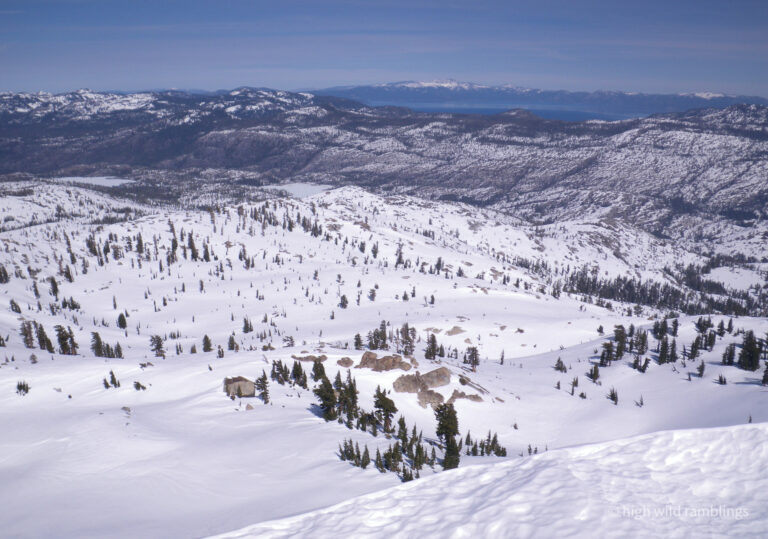
Why should I limit myself to the workings of my own feeble imaginings, when I have the wisdom of the timeless universe before me? Trying to bridge the gaps between my ancient animal brain and my lingual man brain, I train my ear to put the patterns together into a language I can fathom, and learn to trust in my animal perceptions and the sublingual ways they can enter into my decision making. I get the sense that I am picking up on cues in the periphery, below the threshold of conscious awareness, which can manifest in odd fashion.
When route finding, I’ll periodically get the sense that I’ve passed my turn off, shortly before I come to it, even stopping and going back in vain sometimes, only to discover that I just needed to go a little further. I don’t think that’s just my own neurotic self-doubt. It’s as if my subconscious mind somehow inverted the signal to my conscious mind, like the lens in our eye inverts the image of the world before us, leaving our brain to flip it back over in our minds eye. Or does my domineering conscious mind doubt my mute animal brain, saying ‘No, the turn off isn’t ahead, you silly brute. We have passed it.” Recognizing this, whatever the source, I am able to compensate, and hit my mark. It’s like correcting for a pull to the right in your steering, you just compensate and re-true your aim.
Walking with dogs in the wilds, you learn to watch them, to see what they are picking up on, with their superior senses. You can see them cock their ear or raise their nose, testing the breeze and you measure their reaction. And then you try to preempt whatever knuckleheaded impulse they are likely to leap to. This is almost the sense I get, when observing some of my own impulses in the wild. I try to exercise the discipline to correct accordingly, but also to try to interpret the reaction and discern its faint stimulus.
The view here is stupendous. I gaze fondly across my domain, greeting each familiar spot, seeing new things about old friends. It is novel for me to view this terrain from the west and I look for new vantages on my various byways. The route that I took down off the crest this morning follows cross-slope accurately to the only little strip of snow that crosses the cliff band that runs along the base of the slope, as if I knew what I was doing. I can just make out the top of the Striped Crag where it peeks out above the Sierra crest across General Creek, and my eye wanders on down to Tahoe, visible now like a blue mirage, so still that Mt Rose shimmers in reflection, fifteen miles away. Tahoe is so big, it looks bigger from back here than it does up close. The broad bare expanse of Rockbound Valley lies before me, between my tips, containing a vast basin of air within its walls, rising and falling with the sun, inhaling and exhaling.
The northern extremity of the Crystal Range crests like a wave, it’s cornice built up, hanging out in space. The Rubicon River drains down to where it makes a hard left around striking McKinstry Peak at Hell Hole. I measure McKinstry’s distance to Tahoe by eye, figuring I might be able to ski it in a day from the west shore. It’s conceivable, I’ve done it in the summer, but with a big headstart in my truck. That would be a notch bigger than this tour for sure, I muse. Speaking of which… I snap from my reverie, reminded of how far I’ve yet to go here today. This was the easy part, getting way out here. Now I’ve got to get my ass all the way back (close doesn’t count).
It is a powerful urge that propels me towards the horizon, to peer over the top and see what might lie beyond. There is something so seductive, in what is hidden. Our mind delights in filling in the blanks. From the fastness of my mountain stronghold, my home nestled in the Sierra, deep in the Tahoe basin, I climb to the far rim to peer over at the real world beyond, with perverse pleasure, in awe of the mass of human industry that busies itself below. There, but for grace, go I.
From the crest of the Crystal Range, the Central Valley, lies shrouded in a grey haze, only the very peaks of the coast range beyond stick up through the cloud, two hundred miles distant. Great plumes of smoke rise from the foothills, where controlled burns consume forest litter. I have an instinctive impulse to recoil, to slip back below the ridge top, to avoid detection. I fear if they really knew just how free I am, they would need destroy me.
I feel a bit like Ishi, the last wild West slope Indian here, who finally gave up and wandered out of the northern Sierra in the early part of the last century, the last of his kind, leaving behind a primeval world that had sustained his people for many thousands of years. In a single generation, that way of life was erased. The Nature remains, in part, but not the people who could live completely immersed in it. Even the remaining natives among us, live modern, mediated, technological lives. This is not about intention or purity, but rather the pervasiveness of our ubiquitous culture. It’s just the water we all swim in.
I pull on a jacket against the ridgetop breeze that cools the sweat on my back. I remove my skins and tighten my boot buckles, preparing to descend. I am right on schedule, yet I find it hard to relax and enjoy my time here, knowing how far I have yet to go. The push to make the summit has energized me, but now that energy ebbs and I feel the fatigue. Problem being that I am actually only half done with my journey, and the most strenuous part will be this ski descent. I know I should eat some more but I am anxious to see what the snow conditions will feel like for descending, afraid the snow will begin to firm up as the slope descends into shadow again. The breeze teases at the edges of my peace of mind, urging me on, anxiously.
Alright then, time to ski. Six hours of steady hustle, and I am finally ready for a ski run. I glide back down along my up track, tipping my skis onto edge as I gain speed, dropping into my telemark stance; my lead ski crosses the fall line, carving a turn. I shift my weight slightly back onto my trailing ski to rudder, then tipping back into the fall line, as I bring my back ski forward, linking smoothly into my next turn. With these floppy three-pin bindings, I have to really mind that back ski, consciously weighting it and feeling it sweep and bite beneath me, flexing. Then, rotating my trunk as I plant my opposite pole, winding up the spring, to initiate my next turn. It is a gloriously precarious dance. You set the wave in motion, then ride it, like water carving a sinuous canyon.
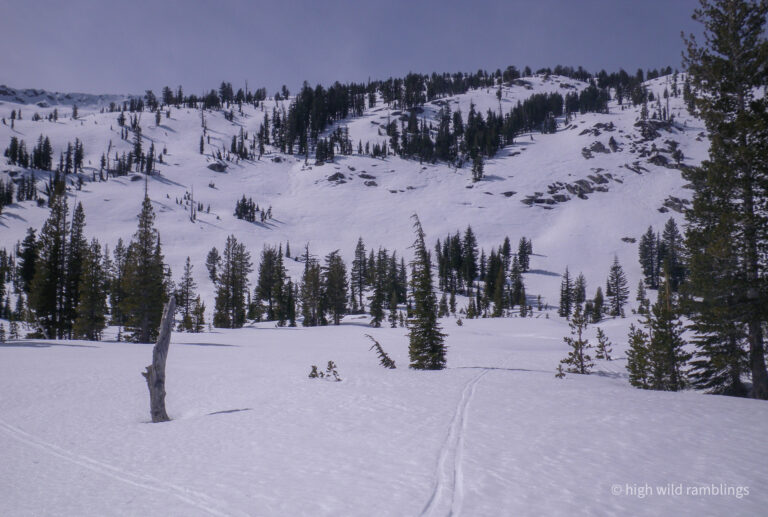
The telemark technique was developed hundreds of years ago in Norway, where skiing was just how you got around in the winter. The technique allows one to control speed when negotiating down a steep hillside, in lightweight free heel ski gear, by turning back and forth across the fall line, with an open striding stance that allows fore and aft stability. The advent of mechanical releasable bindings that allow you to safely lock your heel down and stiff plastic boots that effectively eliminate the joint at the ball of your foot and greatly stiffen the ankle joint lateraly, allowed one to edge the ski with greater leverage, from the knee. Control for descents was greatly enhanced, but upward mobility was hampered, which is where mechanical ski lifts become necessary, or mechanical Rondonee or Alpine Touring boots and bindings that allowed for locking or unlocking your toe and ankle flex, like most of my partners use.
My gear for this tour is a more modern hybrid; lightweight metal-edged skis with side cut and a smooth, round flex to facilitate turning, and a raised fish scale pattern underfoot to allow for kicking and gliding, the shuffling stride necessary to cover rolling terrain. My boots are molded plastic with a couple of buckles and a molded bellows at the ball of the foot to allow for some flex there. This setup doesn’t really do anything very well, but it will do just about anything. Altogether, it weighs a few pounds on each foot, sort of like deep-sea diving boots, except they go both ways, they’ll ratchet up the mountain, as well as glide back down.
Telemark skiing enjoyed a niche revival in the late 70’s, as gear technology improved to satisfy the youth of the emerging consumer culture’s urge to assert their rebellion against their square parents. As ski fashions have continued to change, towards speed and stunt skiing, more camera-ready and conducive to marketing, the difficult technique has been relegated to the fringe, particularly on the lighter weight more touring oriented gear that is ideal for tours like this, where I am covering a good deal of mileage but also need to be able to make technical ski descents with a measure of control and grace. The real reason I love the telemark turn is because it allows such freedom of expression on the descent, particularly when powder skiing. Less control means more sensitivity. Its loose lightness makes me feel like I’m stepping on air.
The snow on the ramp skis just fine. It is solid, underneath the half foot of new snow we got a week ago, now successively melted and refrozen down to a couple of inches of consolidated corn snow, which is softening nicely in the direct sunlight. From below, it looked like I could drop off the ramp onto the steeper face directly down to McCon Lake but from above it is hard to tell just where I am, as usual. I roll in on faith, divining where it looks plausible, the terrain revealing itself as I drop, turn by turn, trying to think like a glacier.
The pitch steepens significantly and I shift gears, directly linking my turns, carrying the momentum from one to the next continuously, pogo-sticking, keeping my skis more in the fall line. This tight turn cadence is committing but once you get it going it flows on, of its own accord, fluid mass in motion. This is the groove skiers are after, when the rhythm of flexing skis and yielding snow takes over, compress, extend, absorb, then let fly, for that magic moment of weightlessness, land, and repeat, till fatigue overtakes your momentum. It is sheer bliss, an inexplicable connectedness with the dynamics of the universe. Mass in motion. This technique is quite tricky in such light weight gear. It’s all about maintaining body position and form, with little ability to recover if things go awry. As long as I stay poised and tight, my weight distributed, my hands held low in front of me, the rhythm of turning will carry me on.
I crank turns till I am panting from the exertion. I can see now where my line maneuvers through some tight trees and opens up again rolling even more steeply to the lake. Relieved that my route appears to go, I finally note the speedy feeling in my chest and a hint of lightheadedness, acknowledging my body’s plea for calories. I resist the urge to keep skiing, delaying the gratification, knowing it will be increased. I know better than to ignore such indications of an empty tank, and pull up in the shade of these trees, out of the breeze, and eat a bit more.
The pizza wasn’t sitting all that well, so I eat half a peanut butter and jelly sandwich. Homebaked sourdough pumpernickel, homemade wild manzanita jelly, crunchy organic peanut butter. For me this is comfort food, like mother’s milk, part of my daily routine since childhood, which isn’t to say that I actually enjoy it that much. My body burns it clean though, and I know it works. Periodically though, with my fatigue and dry mouth, I need to remind myself to keep chewing.
I figure I shouldn’t be dehydrated anyway, as I have been drinking heartily from various creeks I have crossed. This is a real advantage of my approach to hydration on this trip. By drinking from the creeks I am able to consume a greater quantity of water than I would otherwise be inclined to carry. Dry mouth is constant from all the mouth breathing, but I know rationally that I am as well hydrated as I can be, regardless.
My feet are sodden, nearly squishing, and I take off my boots to air things out a bit. I have brought spare socks and when my feet have dried and are getting chilly I put them on. Feeling like a new man, or new feet anyway, I resume my descent. Sometimes a reset is key.
I gingerly seat the holes in my boot toe over the pins on the binding and snap the bail into place, making sure I have the right ski on the right foot, & keeping my fingers crossed. It all comes down to this simple click. These bindings make me nervous when I’m more than a few miles from terra firma. Putting the right ski on the wrong foot will distort the pin holes on the boot sole, making the already sloppy boot binding fit worse or even nonfunctional. The lightweight aluminum toe pieces and bails are prone to inevitable fatigue and failure. I have broken a number of these through the years, though with out consequence, and check them for signs of excessive wear before each ski day. If my bindings failed way out here, I would be spending a long cold night trudging home, at best.
These routine binding checks have taken on an air of ritual, the careful habit becoming a bit superstitious, and the fearful emotional side of my thinking seems to reinforce the rational. This is a curious human trait, but does it really encourage mindfulness? Merely touching the bindings out of rote habit does little for me if I don’t actually carefully scrutinize the metal, looking for hairline cracks. So does the ritualization of this habit actually make me safer, or is it a mere distraction? Constantly checking my systems out here is what has allowed me to hone my efficiency. As I age, this is increasingly the source of my strength, the exercise of disciplined reason. But to find errors, you must be looking for them. That air of certainty that the experienced are expected to project is an obstacle to actual mastery. True mastery is born of ongoing rational self-doubt.
This paradox, I believe, is at the root of mankind’s chronically poor history of leadership. There is a disconnect between the self-assuredness and confidence that we emotionally equate with leadership suitability, and the self-questioning and uncertainty that are prerequisites for actual learning and good, sound decision-making. Maybe we should try putting geeks and scientists in charge, instead of salesmen and actors.
A pair of ravens glides down the crest towards me, curious as to what the nutty monkey man is up to now. They effortlessly have their way with the gusty winds aloft, banking and rolling, dipping and diving, showing off, no doubt, for each other, and maybe even for me.
Left then right, that’s how this works. I swing into the fall line feeling my edges bite into the softening corn snow letting my muscle memory take over, I link tight hop turns, reaching way down hill to plant my pole, popping up from my tele crouch, to lift and tilt my skis into the air, across the falline for that blessed moment of weightlessness, poised pointing strait down hill, as my skis recross the fall line and I land carving and reach again for that next pole plant, grinning like a freak. The slope steepens, rolling out of sight before me, revealed turn by turn, like a striptease.
Blissed out, feeling godlike, there suddenly appears below me, over the convexity’s horizon, a gap in the snow where it has pulled apart across a bulging slab beneath. I open my turn up to time my leap over it, landing below it, going too fast, I try to reign it in, stomping on my edges. I am thrown back onto my hind ski which washes out, bouncing me on my ass as I finally get my edges to bite. Dude! I exclaim to myself accusingly. I know I need to make each turn like I mean it. I look down at the offending ski, forcefully reminding myself that I am on this light weight set up, not my usual cable bindings on beefy descent skis, which offers so much more control and margin for error. Dismayed, I see that I have failed to flip down the lever that locks out the rearward flex in the boot. Duh. So I didn’t fall just because I am weak. I also fell because I’m stupid. I get up, brushing the telltale snow off my ass, feeling demoted from my superhero status of moments prior, pride going before the fall. I self-consciously checked to see if the ravens were watching when I stepped on my cape.
Humbled, I resume my descent, consciously emphasizing the pressure on the rear ski, swinging turns down to the lake with exaggerated intention. I resist the urge to carry speed onto the lake, concerned that the flat lake surface may be sticky from too much direct sun, trying to avoid another abrupt, upclose and intimate encounter between the snow and inappropriate body parts.
I shuffle across the lake to intercept my up-track, turning to look back at my descent tracks. The gentle treed slope is such a natural route, improbably easy amidst steep open faces. It is as if it were put there just for ease of travel. I decide to call it the Three-pin Ramp, on my personal map. At the lip of the bench beyond the lake, I survey the faceted terrain below me. I could cut north and ski next to the Leland Creek waterfalls above the Rubicon River, but, glancing across at the distant Sierra crest that I still need to get up and over, I elect to stick with the plan and follow my up route back down, rather than risk the unforeseen on a steep, blind route, overriding the adrenaline-fueled over-stoke, like the mature skier I aspire to be. I link lazy turns amidst the granite outcrops and isolated wind sculpted Junipers and Jeffrey’s, feeling like part of the grand beauty. Crossing the outlet creek from 4Q lakes, across the grain to contour up over the gap that will lead me down to my crossing of the Rubicon, anxious to see how melted my snow bridge might be.
I arrive at the river precisely on time. It’s almost silly how often I arrive somewhere on the even hour, or within a couple of minutes, time quanta. I’m not sure what to think, really. I know timing certainly doesn’t necessarily imply causality, but I also know there’s a whole lot we don’t know, and that reason tends to focus on what it can discern and explain, and tends to ignore what it cant make sense of. I know better than to ignore coincidences, and find them vaguely reassuring, like some sort of affirmation beyond my ken. It’s all in the timing and quite often the rhythm is not so easy to discern with our rational mind. Do we have a vestigial sense organ for that?
A couple of days ago, it had taken me four and a half hours from here to home, and that is just how long it is till dark, headlamp dark when all forward progress slows to a crawl, and I need admit to an error in judgment and execution. My mission loses some of its elegance and becomes a bit more of a contrivance, at least according to the challenge I have set for myself. Late finishers in the Western States 100 don’t get a belt buckle.
I approach the snow bridge tentatively, scanning the banks. It is in the mid-fifties and has been for six hours, cooking in the high Sierra sun. I can see where the bank has collapsed in places, as it has softened, and as the river has risen and undercut it. I tentatively probe the approach to the snow bridge with my pole. It sinks in a good foot through the crystalline saturated snow, but it is still frozen firm underneath. That’s the rain layer from a big warm wet November storm, the atmospheric river, that froze as a couple-few inches of clear water-ice close to the ground.
I unbuckle my pack and remove my pole straps, grimly contemplating the implications. Easing out onto the boulder on the near side of the span, I try not to look at the current rushing by. I push off, trying to step across gently as I am gliding, and holding my breath for good measure. And then, it is done, and I feel a bit giddy. I take a celebratory solar hit, dip a hearty draft from the icy cold current, and shuffle on up my trail, back on the job.
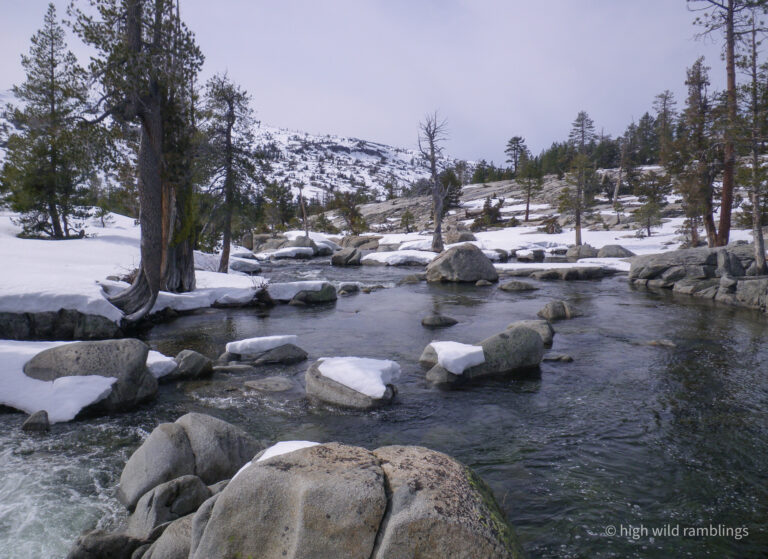
The snow is sticky enough that I don’t need my climbing skins now, finally. A couple of days ago, I didn’t need them all day, but the snow has sufficiently transformed and refrozen, such that today I needed the skins for purchase when climbing this morning. This also means the snow was sufficiently transformed for decent descent skiing. My timing was good. Conditions were perfectly marginal simultaneously in each of these two converging trends, the freezing and thawing. That’s as good as you can plan for.
This west slope in the afternoon sun is plenty soft now, and I work up the gully that constitutes the head of Nighthawk Creek, following my track from a couple days ago. This morning it was too firm to leave much of a track coming down. From the Crystal Range I could see that this gully holds the only strip of snow that climbs continuously up to the bench below the Sierra Crest. I sure am glad I know where I’m going, at this point in the day. Nothing I can see in either direction looks remotely passable right now.
Fatigue has set in, but I am largely numb to it, just grooving along feeling no pain. I’ve reached that point where I feel I could just keep on like this, indefinitely. This is what I do. My daily practice. I cover ground, all day. It’s what I have grown into. I feel more at one with my place here, than at any other time, as I near exhaustion and my conscious rational mind starts running out of blather and finally shuts up, letting my primeval body just do what it knows, self-possessed, not self-conscious.
I know this route quite well from years of off-trail summer travels in this neighborhood, and traveling it now on snow is such a treat. I am glad for the extra challenge of covering this ground in marginal snow cover, just enough to get through efficiently. If I had come in full winter conditions, when all these details were buried, then the route finding would have been much simpler and wouldn’t have required such intimate knowledge of this terrain. I relish the opportunity to put my mindful experience to use and eagerly recognize each juncture on this long familiar route, adding texture and detail to my mental map of my home, further inhabiting this place. I relish returning in the summer, and shaking my head to think I had actually skied all this.
I remember working up this slope with my girls (wife and daughter, plus border collie) coming back from a sweet late summer backpacking trip to the Rubicon River when our daughter was a teenager. We had four wheeled for a couplefew hours from home to approach it. And here I am having skied it all, out my back door, under my own power, fueled by nuts and fruit. I sense the juxtaposed scale zoom out a level, with a subtle wave of vertigo, recalibrating that map, the space inside of me expanding to take it all in.
I feel blessed to have been able to develop such a long standing relationship with this place, and visiting it now on skis as part of such a spectacular ski tour feels like a consummation, a rare and unexpected gift. As if this place has welcomed me in deeper still to a level I didn’t even know existed. I feel at once humbled and powerful, no bigger than a drop of cascade spray, no smaller than the Sierra batholith, a mere flash tracking across the landscape, reverberating deeply on. I yearn to glimpse what it is to truly inhabit this incredible planet of ours, to truly belong to something so vast? Could this be the next valence in the emergent awareness; the self-conscious cell, knowing full well that it is a part of something so big that it can not know it.
I remind myself to watch where I’m going, like calling a dog back to heel, as he strays out of sight, with a just finger pop, or two. Good dog.
My old track up this slope from a few days ago is apparent and following has been a nice break for my attention, almost like having a good partner out here. Thanks for breaking, bro. Much of endurance in rough terrain like this, where each stride is different and each step must be placed, comes down to the ability to stay focused. It is interesting to see how my partners and I continue to expand our range and endurance as we progress through our forties, our mental game entering it’s prime, even as the trajectory of physical trends wanes.
I watch for where I crossed a sizeable seasonal creek on the way down, running in a granite sluice, making for a gap in the surrounding brush. A snow bridge forms where the snow has drifted in, protected by the shade. The creek rushes beneath, now a freshet in full melt mode. Dubious, I push off and glide across, feeling the snow collapse under my tails as I glide onto the other bank. Looking back, I chuckle as the creek takes what is left of the snow bridge along with it on its headlong plunge to the sea, and yet another door closes behind me. This tour won’t even be possible in a few days. There’s a lapse in the snow here, and I march up across the oak bushes to get back on the snowpack. Skis kind of float on brush too, but they don’t grip so great, you have to place them, staying level, aiming for stout branches, with both skis and poles, dry tooling.
Gaining the bench, I can see the low rounded profile of the forest on the Sierra crest and the glaciated granite knob that is my landmark, which I need to traverse below, resisting the urge to climb too soon. I am able to kick and glide again now, covering ground efficiently. Having the skins off for that climb was so nice, the skis moving cleanly over the snow surface, the edges biting positively, side stepping lightly as the tails follow my boot instead of flopping like a rondo rig, working the subtleties in the snow surface, precisely placing each foot like slab climbing.
Skis feel so much more natural without skins on, more like a part of me. It takes more care to place them just so, across the fall line, so the subtle fish scales will purchase, but the trade off is a much cleaner, more efficient motion over the snow. Climbing skins are a blunt instrument. This is much like the trade-off I make descent skiing free heel instead of locking my heels down, like my regular ski partners. By giving up some control and ease, I gain sensitivity, and grace. But most are too proud to struggle, unwilling to risk falling, as if it would be losing face. Instead they lose out on authentic experience.

A tour like this is only possible on this sort of gear, with the uphill, downhill and cross-country skills to ski a full marathon, over a vertical mile of, at times, steep technical relief. And this is why I do it solo, like most of my longest tours, because everyone else is on the wrong gear, because it is out of fashion, because they think like the herd, and would rather schuss the same old chute on Braggart’s Peak, than go explore inside of themselves to see what is in deeper. Mostly they just don’t have the time and dedication to hone the skills, over booked, spending their time working to pay for all the things.
I roll my eyes as I watch yet another cool, authentic scene be overwhelmed by hordes of mindless jock posers, trying to turn everything into a contest, treating our holy place like a gymnasium. Not out here though. They may look out here longingly from the resorts and the front range, wondering, but they don’t have the beans to ante up, and won’t commit the time. They won’t strip away the encumbrances, the false security of excessive gear, because they don’t trust themselves, and so they are chained to their tools and their sketchy, wishful internal maps, more focused on the posing.
Head down, I follow my old track, letting the rhythm of my stride carry me along, leading me into a group of boulders strewn like furniture at a yard sale. I smile, recognizing this spot from a few days ago, which now seems so distant. I was a bit spun here that day and sprawled, to force some calories down the hole, feeling a bit apprehensive about making it home by dark. Today I’m feeling good, and I’m on schedule to make it out just fine. So far anyway, I remind myself, looking over my shoulder.
And so, on I cruise, gently contouring across slope, under the outcrop and around onto a shadier exposure where the snow lies deeper, and the forest is thicker, still traversing, following my faint track, trying to correct for spots where I had to work through tangled spots the other day. Gradually, my tack wraps up onto the crest, as the mountain dips to meet me. Skis are the perfect tools for tracing smooth, clean lines across the landscape, the way you might with a pencil or brush or cursor, bending to the curves of the terrain, further accentuating the arcs and parabolas that the sensuous snow cover reveals, carving around the tops of convexities, caressing the hollows, slow dancing with the landscape.
As the terrain levels, I try to relax my stride, exhaling deeply, blissing out. The forest is open, old-growth Red Fir and Lodgepole. I keep an eye out for the Pacific Crest Trail, looking for the subtle swale, cut branches or old blazes down near the snow level. There is probably six feet of snow here, so I suppose the trail sign is buried.
I come upon the remains of an old snowmobile track. Just a single track, out and back, following the crest. He knows where he is going, no doubt, and that he is trespassing deep into the officially protected, nonmotorized Wilderness Area. Surprising to see he’s riding solo, pretty bold, for a snowmobiler. This is probably an accustomed, favorite place, one he has been coming to for years, as I occasionally do see sled tracks here in the PCT corridor. I bet he can feel his exposure, sense just how far from civilization he is. Tell me about it, boy.
I try hard to push aside bitterness. We are neighbors. Live and let live, right? Just don’t do brodies on my putting greens, bro. For him, it is only natural to come here. I know how he feels. But it’s not some abstract domineering Forest Service authority he is thumbing his nose at by trespassing, it is me, his neighbor. So, fuck you too, buddy. He can ride pretty much anywhere he wants in the other directions, for a hundred miles, but no. He has to have it all. More more more. That’s our problem. It’s all just one way, there’s no restraint built in, no checks, no balance. There are places I could drive my truck or ride my bike that I won’t because I know it isn’t right, it is hard on the resource and it disrespects my neighbors, while it betrays the reasons I come here in the first place. It’s self defeating. Just because we can do something doesn’t mean we should. It will be our epitaph.
Without rules we have no society, no neighborhood. With no stop signs, we will crash into each other. With no respect for our fellows, we have only strife. There must be a line we can acknowledge beyond which we will go no further, we must know bounds and restraint, if we are to live together, which of course we must. The romanticized freedom of the libertarian Wild West could only ever exist on a temporary frontier where there is space for a few people’s thoughtless ways, but this cannot last for long, as more people follow. It is not really real, just a childish fantasy of a world with no parents, which is all fun and games till the bills come due. This is why we can’t have nice things. Society needs rules, and good people voluntarily submit, so everyone is protected from the aberrant bad actors. This is the social compact, for the greater good. Anything less is uncivilized.
I stop to piss on his track, like a wolf marking territory, and continue on, over it already. His loss. The reliance on machinery just shields people from the connection with nature they are really after, deep down, and it makes folks weak and ineffectual and scared, so they act like bullies, exercising their unfair advantage to compensate, and at some level they know it, and so over-compensate some more. How sad. For us all.
I work towards the east edge of the rounded crest here, breaking out of the forest so I can see back into General Creek, my home drainage. Tahoe itself is out of sight, but I recognize the mountains far across on the east shore, and intuit the vast, water filled void between us. I can just see the top of Striped Crag, where the creek makes a hard right towards the lake, and beneath which I must travel. I point my ski tips in that direction, following the Crest to where I can readily drop down into the valley. As I go, I break the trip down into sections, dealing with one piece at a time in manageable bites, to keep my head in it. This is how we approach big problems, we break them down into steps. I try not to think about how far I still have to go, just keep on shuffling towards the next juncture. Following along the crest, I admire the view of the backside of my familiar lakeside peaks.
I can see where Lost Lake lies hidden on the ridge top directly across canyon, a popular backpacking destination for folks in my town. The early miners of the Gold Rush era named most of the features around here, and there are several Lost Lakes around, and they all share this peculiar off-stream geography, being improbably perched up on a ridge top, rather than down in the drainage, as if the lakes themselves had lost their way. They are spring-fed, glacial carved hollows, likely dwelling for long periods submerged in deep glacier ice, but still pooled and flowing, improbable liquid jewels in high forested settings.
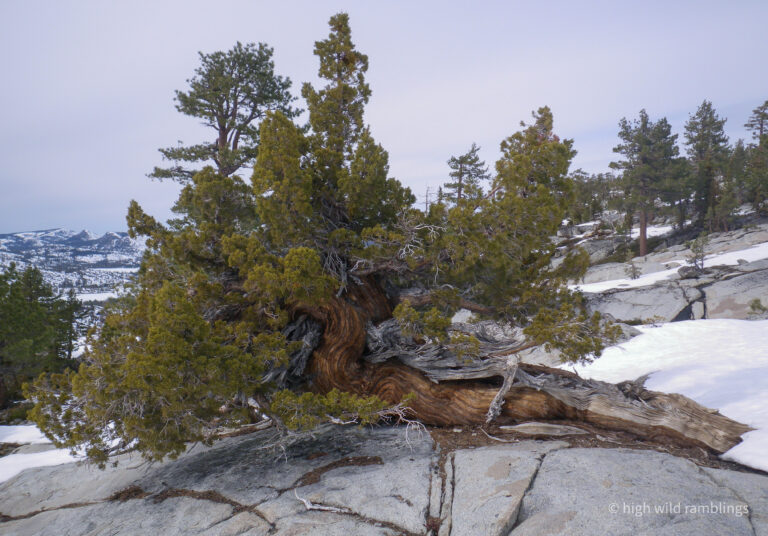
I make my way along the crest, north towards distant Lost Corner Mountain. This similarly odd appellation is curiously unrelated, but rather a reference to the original nineteenth century land surveyor’s section corner monument, a pile of stones or such, with inscriptions on carved blazes on big trees nearby nearby, which subsequent surveyors were apparently unable to recover, possibly because it was never set. There was some notorious corruption in a local surveying syndicate in the area, in those heady times of easy money. Likely the name also referred to the steep granitic southeast face of Lost Corner Mountain, which was repeatedly blown out by passing glaciers.
And while we’re on the subject, General Creek is named for General Phipps (yup, Phipps Peak and Creek too) who was the first white guy to settle on the mouth of this creek, after the civil war. He was a hunter and trapper and is said to have protected his homestead from the loggers of the mining era. I’m sure he knew this country intimately, and I bet he knew a thing or two about snow travel.
(I have since learned from the State Park archaeologist that Phipps was quite antagonistic to the natives, and became a self-proclaimed ‘General’ in the Indian wars, and his name here is considered a desecration. In 2025 the Park renamed the campground Dukme’em, after the original Washoe name for the drainage)
Before the east flank of Lost Corner Mountain becomes more cliff-like, I drop off the ridge on my accustomed route to and from the valley floor. I call it Rattlesnake Ridge as a cautious reminder to myself. Rattlesnakes are quite rare within the Tahoe basin, so I am not in the habit of being alert for them here. But one July a few years back, I was walking towards the base of this ridge when I noticed a couple chickaree squirrels raising a ruckus. Distracted, I walked to within a few feet of this big old, coiled rattler buzzing angrily in my path, which of course is what the squirrels were so worked up about. With a start I jumped backwards into the air, doing some sort of spastic moonwalk move. I stood back, amazed, heart pounding, as the snake slithered off, quite relieved to have not been bitten, alone, seven miles from home. Ever since, I turn my snake sense scanner on from here west. No snakes today though, I reckon.
This is fun ski terrain, little corridors of snow wandering down amongst glaciated granite outcrops, like a maze of low-walled passageways. I pass a familiar old Juniper, one of the biggest ones in the neighborhood, probably most of a thousand years old. I cross and intertwine my two other tracks here from earlier this week, playfully adding my mark, for no one to see. I fancy the wizened juniper is amused by my antics, in his own junipery way.
There is a distinct ridge sort of feature, probably of glacial origin, that leads diagonally across the valley floor, towards where General Creek doglegs lakeward, and I follow it now through open Western White Pine forest and scoured granite slabs. This moraine rib makes a convenient route-finding ‘rail’ to follow through the otherwise thick forest, on a diagonal cross-canyon tack, that would otherwise be tricky to keep to, down in the forest with landmarks no longer visible. I can picture the patches of fragrant Labrador tea and crimson-leaved Mountain Blueberry that lie beneath the snow.
I ski past the boulders where I staged my ski gear years ago, the first time I skied McCon Peak from this side, as part of a nine day spring skiing/fishing backpack trip with my wife. I had come up the week before and stashed my ski stuff here and placed a food cache up on the Sierra crest, at the top of Rattlesnake Ridge. I chuckle at what a production it was, full expedition style. To think I just skied there a few hours ago, and that I’ll be home in another couple, is fairly surreal.
I pause at the creek crossing to dip myself a drink. It is like a little ritualm, maybe the original one. Thank you, Mountain. The waters of my home valley flow in me. The local microorganisms are part of my own intestinal flora. I am of this place, and it moves through me. The sweat on my brow is recycled ski tracks, now evaporating into tomorrow’s storm clouds. Out here, we live the symbolism and poetry; we play our part in the parade, if only for the eyes of the world.
Beyond the creek, I hit the upper General Creek trail, it’s old blazes mostly healed now, just visible above the snow, but it’s shallow groove still apparent, echoing up through the snowpack. At one time this trail was heavily used by pack stock and riders, a nineteenth century thoroughfare to the backcountry Tallant & Velma Lakes from the popular stage ‘road’ from Tahoe to Rubicon Springs mineral spring resort, on the river downstream of Rockbound Valley. Now this trail is seldom used and barely maintained. I leave it before the creek finally bends east, crossing up onto the Snowy Knolls, to cut off the corner, on the same route I have adopted for summer use. Below the knolls, I recross the creek where the trail fords it, getting down into the boulder strewn gulch at the base of the Striped Crag.
This stretch of canyon is rugged and narrow, and as an impediment to easy passage it has protected General Creek from development. It is probably the quietest canyon on the West Shore, with only an inefficient and poorly maintained patchwork trail running its length. But even our meager snowpack is sufficient to fill in the obstacles and smooth it all out for fast, efficient travel. There’s a reason folks have been using skis for over four thousand years. They are a fundamental human invention, integral in the domination of our environment from early on in our development. Beats walking.
I ski along the steep creek bank, admiring waterfalls and cascades where they plunge through the snowpack amidst the glacial rounded boulders, and I carefully recross the creek beneath the gushing little pour off above the Triangular Pools. This crossing too will be impassable in a couple days time. I am so thankful for the little window of time I was offered. As is so often the case out here, it was just enough. And that is all we ever really need, and more than we are entitled to. LIfe is really quite generous like that, you can practically count on it, if you do your part. The creek continues coursing around and over boulders, dashing into deep pools, and I take it all in, as I carefully maneuver my skis over bushes and logs along the steep creek banks. It is a treat to be able to move along here at all. In the summer it is choked with brush and deadfall.
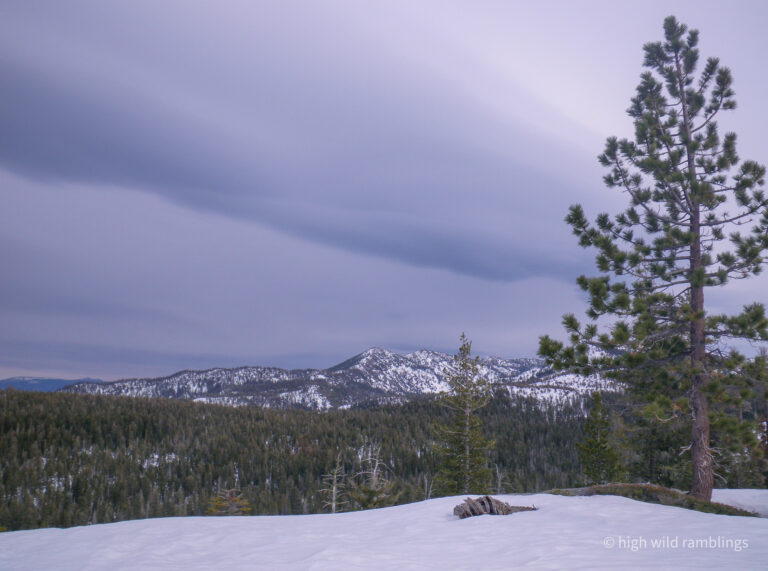
Above the High Meadows I reenter the State Park, the same park that is right out my back door. This is literally the home stretch, only four miles to go. I kick and glide across the lovely open meadows amidst the park-like stands of massive Jeffrey pines. The snow is getting intermittently rotten here, and I punch through a foot deep in places, but mostly it is still supportive. I hope for the best as I head into the thicket downstream. This next stretch is a tangled mess of downed trees and alders with behemoth boulders. I have worked out a route here through the years, and have kept a trail broken here this season but it is a bit of a thrashing in places, even when the snow conditions are good, which they currently aren’t. This may be why no one else ever seems to use it. But the summer trail is on the sunny side of the canyon, and I ski where the snow lingers.
A few years ago some local ‘bouldering’ activists discovered this area and developed these boulders for climbing, cutting trails through the brush, which I do appreciate now. I knowingly schuss through tight spots between boulders, with a blind turn at the bottom, side stepping up over three foot logs, ducking and prying my way through a ten foot tall alder copse, laughing at myself as I try to disentangle my skis from plants seemingly intent on dragging me down, the snow dropping out from beneath my tails, sending me lurching backwards, but I stay relaxed, gracefully accepting my role in this slapstick, my skis know where to be, and one step at a time, I patiently make my way.
On the far side of the thicket, I skirt Olympic Meadows, site of the 1960 winter games’ Nordic events. I imagine the echo of the crowds cheering in foreign languages, cow bells ringing out, as I gamely make my way, limping on both sides. I like to think these ironmen of days past would appreciate my efforts today. But there is no one here to watch today, just me and the wilds, which is as it should be. Glory would only distract from my purposes and dilute the intimacy I feel with this place.
Striding along the remains of the refrozen old groomed double track on my home stretch, I am feeling no pain, positively zipping along, in a slow shuffling sort of fashion. At this point a couple days ago, in my eleven-hour recon tour, my thighs ached painfully, and my brain was running on three cylinders. Today I feel fine. I don’t even necessarily need that hot tub. I’ll take that beer for sure though, cheers. I feel full inside, the bone deep map of my little world having grown some today,

