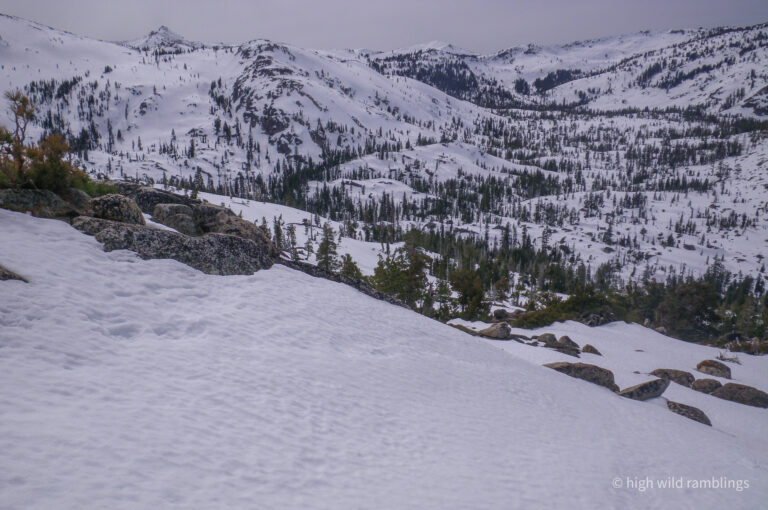
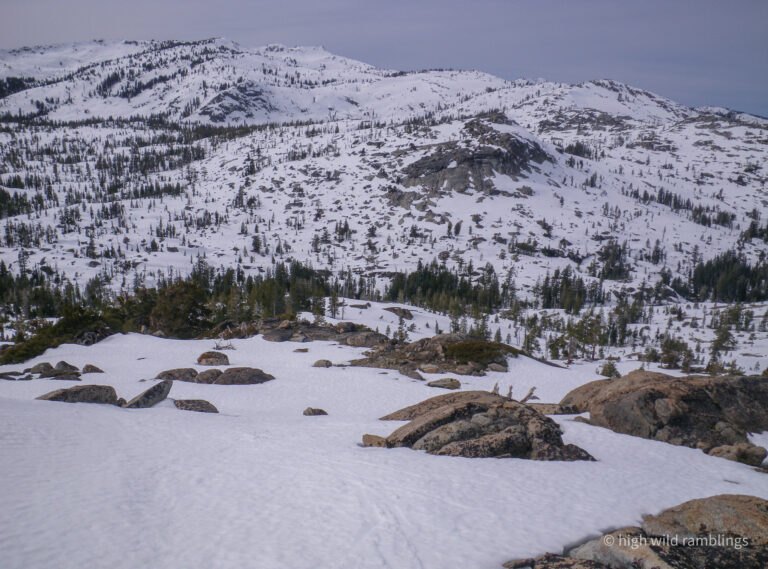
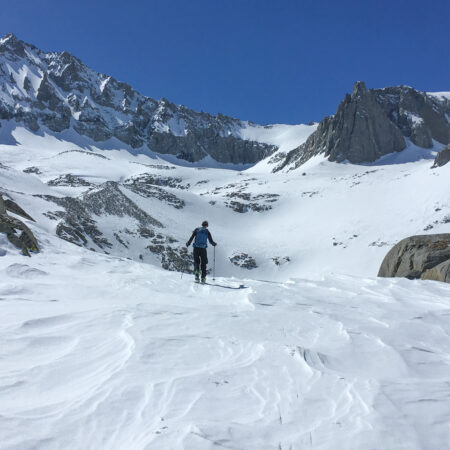
At Snowy Knolls, making good time, five direct miles in two hours, from home by the Lake, just visible in the distance.
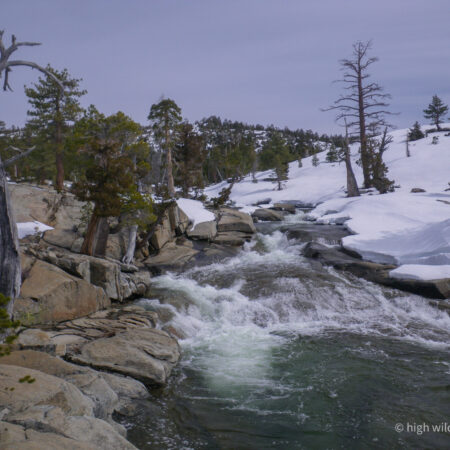
Comforting to have my tracks from a couple days ago to keep me company, as I gain the crest. I came quickly up and over the crest and down the backside again, carrying my skis down around the waterfall at the grotto, where I had turned around a couple days ago. I skied on down the rest of the way to the river, linking intermittent snow patches.
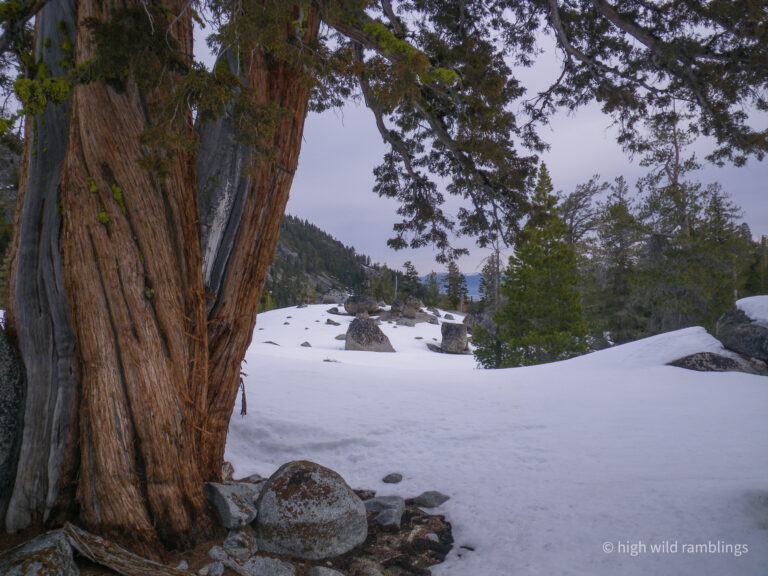
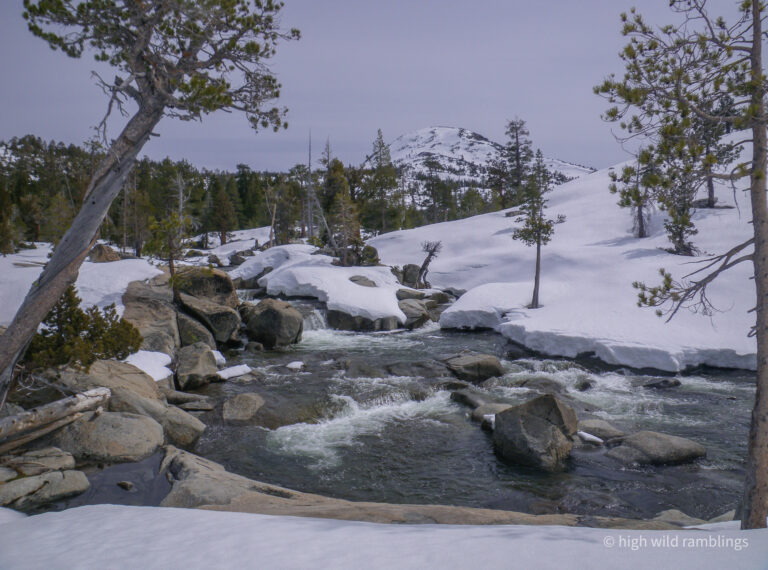
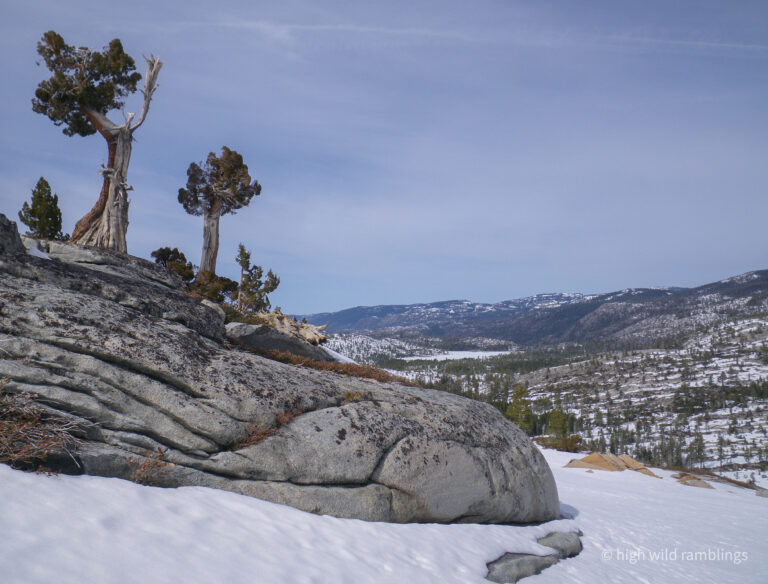
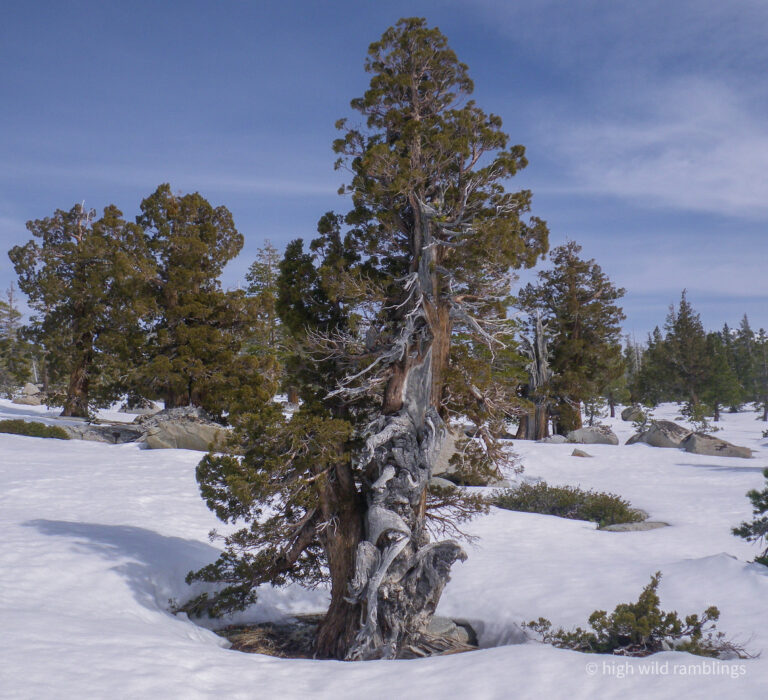
Sierra Juniper (Juniperus grandis), Cupressaceae family. The river was running high, overflowing its banks, at the Kink, as we call the big hard left turn in the joint-controlled river bed here, above the reservoir, in the free and wild Rubicon River (minus the sea-run steelhead trout that can’t make it past the damn dams).
The river here flowed a hundred feet wide, out through myriad granite-bound flood channels, with a rushing momentum that was terrific. My main mission today was to see if there was a viable river crossing. That was the next crux of this whole project to ski the Crystal Crest from home. But to think of crossing here was laughable.
It was conceivable to try to swim across the river in the ponds upstream but the water would be butt cold and with skis it would be a clusterfk, I’d need a drybag, etc. And then of course, I’d have to cross again on the way back. And it would likely take sufficient extra time to result in having to ski home in the dark. That all would feel like stubborn, self-serious siege tactics, making a pretense of my aims for connection. No. I would go if the mountain offered it up in a clean, unforced style, or come back at a better time, when it was in proper conditions, or not at all. This was personal, to participate in this great beauty, not for show or profit. This aesthetic helps keep me safe out here, keeps me right with the Rockbound locals. I try to honor that.
I felt privileged to see the river like this, in all its wild glory, snowbound Rockbound Valley in primeval trappings. I continued upstream, hoping for a fresh log crossing or miracle snow bridge, but mostly just for the view. I skied past where Leland Creek came in from the west down the raging falls, now overflowing its frothing sluice, its booming resonance filling the valley. And then Phipps Creek I crossed on my side, with some wandering, and a long, fat log crossing. And here above that confluence is where I most hoped for a snow bridge, since the net flow had now been reduced two sizable creeks worth in the last half mile I had climbed. In summers past, I had crossed on boulders here in pretty high water, so maybe it would hold snow.
Approaching the river here, at yet another right angle joint in the bedrock granite, I could see continuous snow crossing the flow, perched up in the boulders. It looked pretty marginal, but conceivable. I’d have to look closer. The Rubicon rushed by heedless, waist deep or deeper, pumping hard enough to bowl you over, and sweep you into the frothy boulders below. It was about fifty degrees out, the sun baking down on the snow, water running everywhere. I had seen where the river’s edge snowbanks had collapsed in the melt in the last couple days. As the river level came up it undercut them, and as they melted in the hot March sun, and became unconsolidated, they calved into the flow.
Here was that crux of my scheme right here, the proverbial crossing of the Rubicon. I felt I should test it, precisely because I knew I could go back, because I am not absolutely committed like the Roman general of old. But I appreciate the flair for drama, and knowledge of the classics, it displayed on the part of whoever named the river here, likely some gold prospector. They had no love for granite, often attaching some reference to the devil in place names describing the most glacially scoured of granite locales. We got Hell Hole to the north a few miles and Devils Basin to the south. No gold to be found here in the granite lands, I guess, and hard travel. All the better.
I knew just looking at it, what my regular, all-day ski partners would say. Hell no. But I also have a few other partners who wouldn’t be so quick to rule it out. Climbers and mountaineers tend to cope with hazard with a more calculated approach than skiers and runners. You try things out, one move at a time, and as long as you can back out at any time if need be, you can assess it as you go, in a controlled fashion. I wasn’t about to just go for it and rush across this snow bridge, with a show of bravura stunt skiing, but I was ok with feeling my way, probing with my poles, scrutinizing each step in turn, assessing my ability to retreat. And it seemed alright.
And the crux of the crux was a few consecutive big steps across boulder tops, with a couple feet of snow perched on top, and water rushing beneath. I planned my moves, visualizing them, as I unbuckled my pack straps (so I could shuck it just in case I toppled). I planted my poles just so, reached one ski out, and tentatively weighted it, tamping it down to pack a step, taking measure of the snow’s yielding, feeling the base beneath, the point of compression where it would support me. It’s wild the degree of proprioception sensitivity one can develop over the decades of doing this stuff, feeling the snow subtleties through the soles of these rigid plastic boots. Real-time feedback, and appreciable consequences, tend to reinforce the learning.
It felt solid underfoot, so I took a deep breath, and then executed the moves, mincing steps boulder to boulder, with quick, tight accuracy. And it held. No problem. I’m across the river. My relief immediately tinged with the obligation it posed. Now, you’ve done it. So I reckon, now I’ll have to actually face going all the way up the Crystal Range next time? Or make a proper go of it anyway. Gulp That is my ‘Rubicon crossing’, I’m committed to try. We’ll see how I feel when I get home.
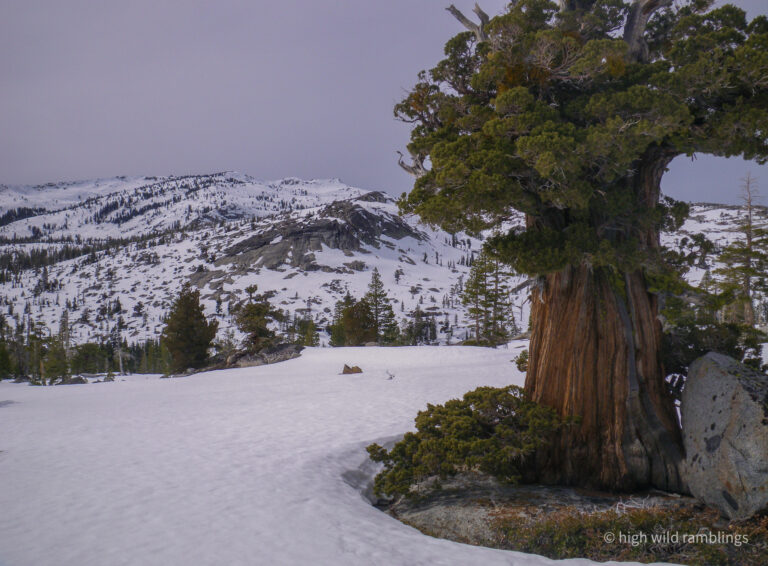
Sierra Juniper (Juniperus grandis), Cupressaceae family. I still had a little bit of time till my planned turnaround time here, so I scooted up the first knoll above the River, to get a look at the rest of my climb to the Crystal Crest above.
Sierra Juniper (Juniperus grandis), Cupressaceae family
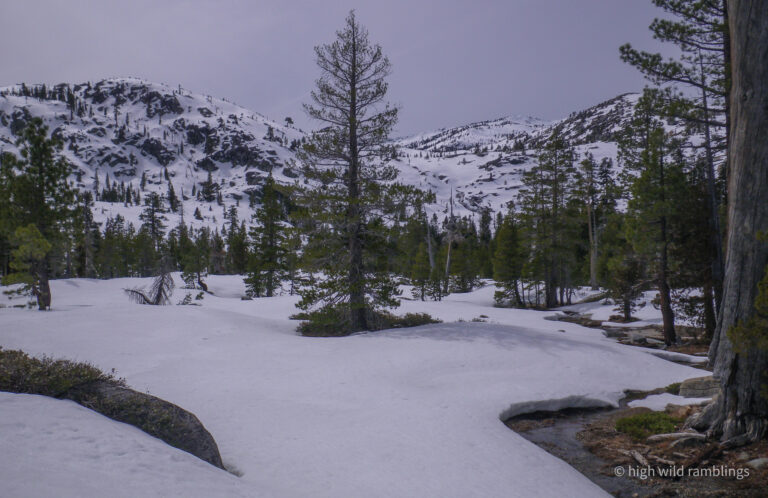
I envisioned climbing this gentle valley, and then the low angle, lightly treed subridge that breaks to the skyline at upper right, which faces south and so will have the most solid base, with the best softened surface, a nice friendly looking way, conducive to my light weight tele gear and long day.
That conducive looking ‘lightly treed subridge’, which I am referring to as the Three-pin Ramp, is visible here at left, leading directly to the crest of the Crystal Range.
So I’ve got a river crossing, till it melts out anyway. On the way home, I consciously broke a gentle, direct trail climbing laterally, up and across the slope seen above, for a couple miles, weaving on continuous snow, towards my low notch in the Sierra Crest at Rattlesnake Ridge, which I would be able to follow upon my return.
The charmed features of this wild landscape sometimes don’t even look real, like the trees are manicured topiary and the rock is styrofoam props, with a CGI snowpack added post-production.
It took me 4.25 hours from the river, home by 6:30 (11 hrs. total, 22 miles, 3,600′). So I should have enough time to cover the extra distance to the Crystal Crest, if I start an hour earlier, and go right till dark. And so there it is. This knowledge has a certain heft to it. I can feel its gravity now, in the pit of my stomach.
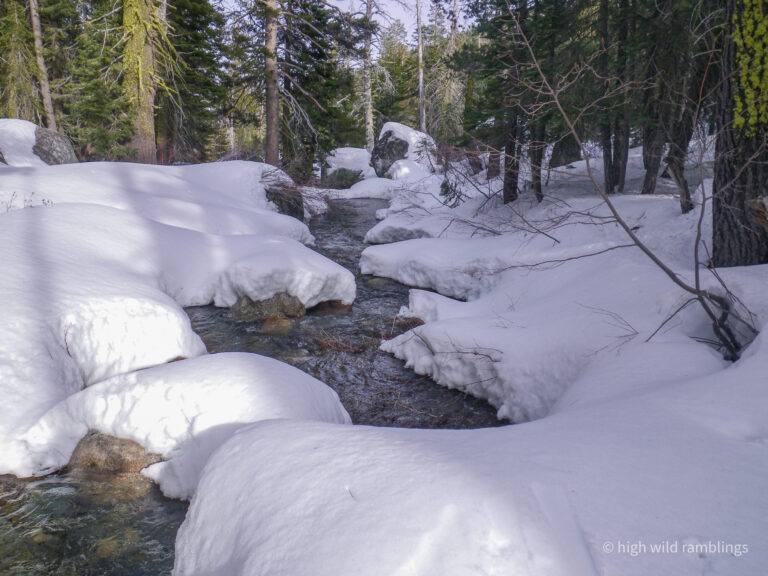
I stopped to dip my little plastic bottle clipped to my pole basket into the creek here at the summer trail crossing, chugging half and saving the rest, drinking as I went, like any other natural born critter.